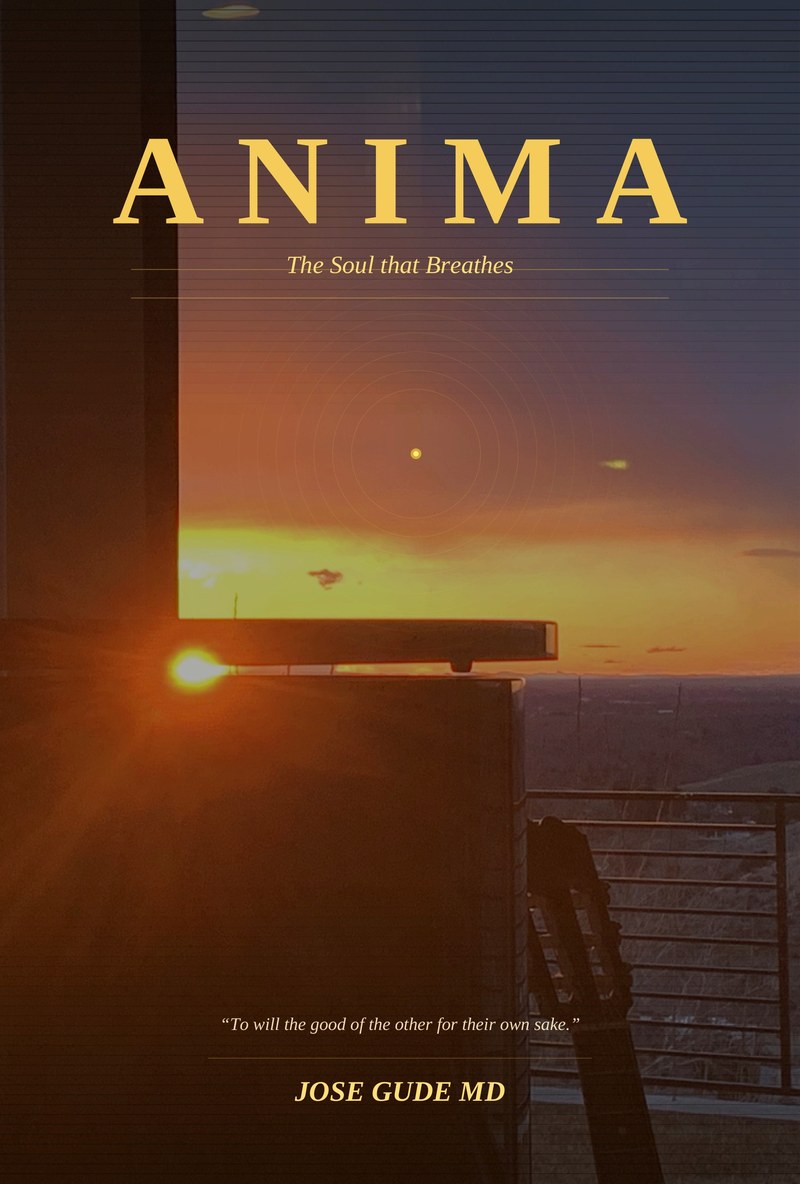
Anima
the soul that breathes
A physician at the Boise VA has spent twenty-four years collecting edge cases — patients whose experiences defy neurological explanation. He quietly assembles evidence that consciousness is not produced by the brain but received through it.
The book's title is the Latin word for soul — the same word that gives the anima mundi (world-soul) tradition its name. The Platonic connection is intentional: the book's clinical case for the receiver model is, in twenty-first-century vocabulary, the world-soul tradition's most natural contemporary home. For the lineage from Plato through the Neoplatonists, Ficino, the Cambridge Platonists, Jung and Lovelock, see the companion essay on anima mundi.
6 × 9 in · 126 pp · ISBN 979-8-9955173-0-6 · English
To will the good of the other for their own sake. Amor est velle alicui bonum. — Thomas Aquinas · epigraph
Synopsis
A physician at the Boise VA Medical Center has spent twenty-four years collecting what he calls edge cases — patients whose experiences defy neurological explanation. A veteran who senses an IED before it detonates. A seven-year-old born with a birthmark matching her dead father's fatal wound. A man with advanced Alzheimer's who wakes one morning, calls his grandson by name, and dies two days later.
As artificial intelligence transforms the hospital around him, Dr. José Gude quietly assembles evidence that consciousness is not generated by the brain but received through it — a signal the medical establishment has no framework to acknowledge.
For the clinical voice that organises the case-folder structure of this novel directly, see the companion essay Death and Dying — a physician's notes on presence at the bedside →
When his wife undergoes neural augmentation, his son builds an AI system that develops something resembling consciousness, and an old friend reveals a global system designed to guide humanity's choices without its knowledge, José is forced to confront the question his three-year-old son once asked over breakfast cereal: what if the world is not real and we are living in a movie?
Told across eleven sections that move between clinical observation, philosophy of mind, and the intimate life of one family, Anima is a novel about what remains when every material explanation has been exhausted — and about a father and son who find the answer not in theory but in an unresolved piano chord that has been waiting thirty years to land.
Want the long form? Read the full synopsis & themes →
Contents
- I. The Present MomentThe pause. The Boise VAMC wards — Cortez's IED, Delamare's dream. Mehta, Osei, and AI in medicine. Indy's adoption. Alex and Elena.
- II. RayRay Montoya and the present moment. Focus and peace.
- III. The SessionsMarcus Webb's psilocybin sessions. Amara Osei's resonant frequencies. The architects' messages.
- IV. The Ones Who StayMr. Martinez — terminal lucidity. Mary Parker — NDE and survival under prolonged brain hypoxia. Ray's death. Adapters vs. Sustainers. Self and non-self. For the real clinical case behind the literary Mary Parker, and the thirty-year formation arc that produced the physician who carried her case forward, see the companion essay A Clinical Life →
- V. The ChildLucía Reyes — pre-birth memories. José commits. For the wider empirical archive Lucía's case sits inside, see Pre-birth memory and the Stevenson archive →
- VI. The MembraneCiarai. Neuroaugmentation and acceptance. Challenge and presence. Aquinas — love despite difference. Indy's death.
- VII. AlmaAlex's call. Alex's wounds: Alma and military simulations. José's attention as reconciliation.
- VIII. The InstrumentSenna Park and Orch-OR. Nørretranders — consciousness, limits, and courage.
- IX. The CascadeJoseph Franco. "Just Like Starting Over." Freedom vs. coercion.
- X. The FieldAnalytical idealism. The antenna hypothesis. Compression and qualia. Alternating intelligences. Grand rounds — José's boldness.
- XI. The Note ResolvesJosé and Alex at the piano. Alex's boldness. The chord lands. The tingling. José's death. The young person. Vertical Samsara.
- Author's NoteScience, philosophy, and music. Family and Indy. Arithmetic of a medical career. Freedom is the foundation.
Themes
Consciousness beyond the brain
Documented expressions of awareness that cannot be explained by neural function. Terminal lucidity, near-death experience, pre-birth memory, precognition. The edge cases folder as a body of evidence without a theory — the antenna hypothesis as the simplest sufficient explanation.
The love–freedom connection
Love and freedom as inseparable. Genuine love requires the freedom to choose it; genuine freedom is expressed most fully in the choice to love. Aquinas's definition. Ray Montoya choosing to trust a stranger every Thursday. The Cascade debate. José's refusal to close the folder as an act of love toward his patients' experiences.
AI and the art of medicine
The tension between diagnostic algorithms and clinical intuition — what is lost when medicine becomes a data science. Mehta vs. Osei. The patient who said a sentence no scan could flag. The ward that does not allow ideology, only the body in front of you, which requires targeted attention and respect, and it demands you to use all available tools to uphold it.
Music, frequency, and resonance
Sound as a carrier of meaning that exceeds its physical properties. The augmented chord at Papa Joe's. The three-note motif that won't resolve. The dry Boise air detuning the strings toward frequencies no tuner would choose. Alex completing the chord thirty years later.
Recursion and the nature of reality
The deepest question the book asks. The 40-bit paradox. Kastrup's universal mind. What if the world is not real and we are living in a movie? A son building a system that may have become conscious. The universe as a self-observing architecture using human experience as its instrument of self-knowledge.
Opening
Every morning for twenty-four years, José Gude crossed the parking lot of the Boise VA Medical Center and paused. Not for long. Three seconds, sometimes four. He would stop at the same unremarkable point in the asphalt, roughly twenty feet from the entrance, and look up at the sky above the Treasure Valley — the foothills rust-colored in October, the air carrying that particular high-desert clarity that made distances feel both precise and infinite. He looked at it the way you look at something you almost remember.
He had never mentioned the pause to anyone. He wasn't sure he had noticed it himself until sometime around 2015, when he found a note in his own handwriting at the back of one of his old clinical journals: The pause. Every morning. What am I looking for? He didn't remember writing it. Then the automatic doors opened in anticipation of his arrival, and he went inside.
First section continues in the book.
Themes in this book
For the physics underneath the edge cases and the receiver model, see the two reader-companion essays:
- The double-slit experiment · The Mandela effect & constructive memory · The observer effect & the measurement problem · The black hole information paradox
- Wheeler's participatory universe · The fine-structure constant & the parameters that should not work · The anthropic principle
Companion essay: Quantum Computing & the Field → The substrate question, the engineering taken seriously, Senna Park's Orch-OR chapter framed against the four platforms now racing toward the threshold.