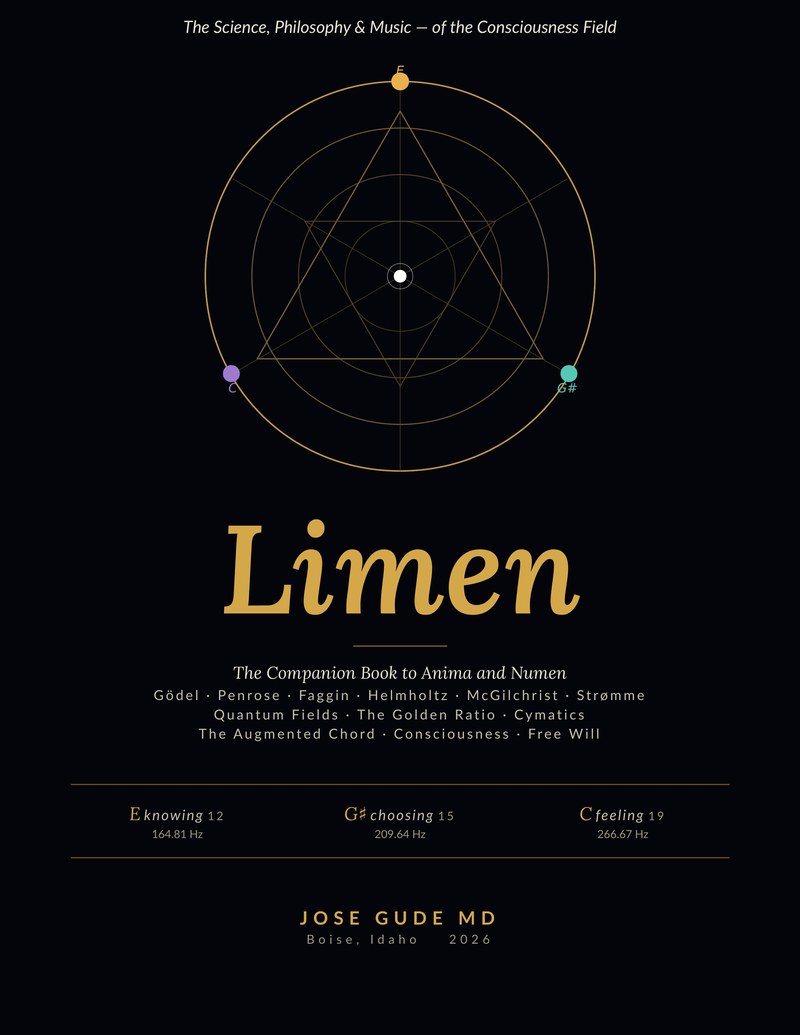
Limen
the companion book — physics, biology, mathematics, philosophy, theology, and the mystics
Where Anima and Numen dramatize the consciousness-as-field hypothesis through narrative, Limen builds the argument from the ground up. It is written for the reader who finished the novels and wanted to know whether the framework was real.
8.5 × 11 in · ~198 pp · Hardcover case-laminate · Twenty-seven high-resolution diagrams
The beginning never ends. — epigraph · the recursion that opens and closes the book
What it is
Limen occupies a genre that has no established name — part scientific essay, part philosophical treatise, part sacred-geometry manual, part dialogue with the contemplative traditions. It is a coffee-table book designed to be opened, browsed, and returned to rather than read linearly from cover to cover. Dark background, amber and teal accents, twenty-seven full-color diagrams.
The booklet's achievement is its integration. No single claim in Limen is original — Faggin's quantum information theory, Wolfram's computational irreducibility, the golden ratio's appearance in biology, the augmented chord's mathematical properties, the mystics' reports of field experience all exist independently in their respective literatures. What Limen does is demonstrate that they are describing the same structure from different angles, and that the structure is coherent. The convergence is the argument.
Want the long form? Read the full synopsis & themes →
Contents
- An Opening Note
- The Physics of ConsciousnessFaggin's three irreducible properties · The body as receiver · Cymatics and the 60% water problem
- The ArchitectureThe four layers and the nested structure of reality
- The Philosophy of RecognitionGödel, Searle, and the limits of formal systems · The properties of the field · Love as precise definition · The hemispheres
- The Music of the FieldThe augmented chord and its properties · The phi-tave scale · The two sequences
- Applied Science: The Body as Frequency SystemClinical evidence · Where the three streams meet · Terminal lucidity and general anesthesia
- The Unified Framework
- The Theology of LimenHow close is the field to God?
- Complete Bibliography
Themes in this book
For the physics, mathematics, and cosmology the compendium integrates, see the two reader-companion essays:
- Dark matter & the field that receives · The simulation hypothesis as one possible reading · Spacetime distortions & the geometry that bends
- The holographic principle & the twenty-seven diagrams · Quantum spin quantization & the augmented chord · Tegmark's mathematical universe & the convergence as the argument
Companion essay: Quantum Computing & the Field → The substrate question, why substrate matters more than software, and what computation can and cannot receive.
An Opening Note
Science, philosophy, and music are the three passions that have shaped the author's life — as a physician, as a thinker, and as a listener. They are also the three disciplines that, pursued far enough, arrive at the same place. What follows is an attempt to show where that place is, and to lay out the sources, the evidence, and the arguments from which the world of Anima and Numen was built.
The stories did not begin as fiction. They began as a physician's private file — thirty years of clinical observations that did not fit the available models. Near-death experiences with verifiable external detail. Children who remembered the circumstances of deaths that preceded their birth. Veterans whose premonitions saved their units with a frequency statistics could not account for. Psilocybin sessions in which untrained patients produced geometrically precise structures that turned out to be real protein configurations. The fiction grew from a question the data kept raising: what kind of universe would have to be true for these things to be possible?
Three disciplines converge in this booklet. Science provides the physical mechanism: Federico Faggin's irreducible quantum fields, the documented physics of cymatics, and the quantum coherence of biological systems. Philosophy provides the conceptual architecture: the Problem of Other Minds, Searle's Chinese Room, and Aquinas's precise definition of love as willing the good for the other for their sake. Music provides the experiential language: the augmented chord, the phi-tave tuning, and the frequencies that both describe and instantiate the structure they describe.
The Opening Note continues in the book.
— José Gude MD · Boise, Idaho · 2026
The argument, in seven steps
1 · Faggin's three irreducible properties
The argument begins with Federico Faggin — the physicist who invented the microprocessor, then spent twenty years concluding that consciousness cannot be reduced to computation. Faggin identifies three irreducible properties of quantum fields: knowing, choosing, and feeling. These are not metaphors. They are what matter is when described at the quantum level — properties that no physical description, however complete, can derive from physical law alone.
2 · The body as φ-geometry antenna
If consciousness is a field that the brain receives, what kind of receiver is it? The answer is geometric. The human body is sixty percent water organized around golden-ratio architecture at every scale — from the cochlea (a logarithmic spiral at φ) to DNA (a double helix whose major-to-minor groove ratio is 1.618) to the branching of the nervous system. Cymatics — Ernst Chladni's plates, Hans Jenny's photographs — demonstrates that specific frequencies create specific geometric patterns in water. The body is a phi-geometry antenna, tuned by evolution or design to receive specific frequencies of the consciousness field.
3 · The augmented chord: E · G♯ · C
Three frequencies in exact φ-ratios — 164.81 · 209.64 · 266.67 Hz, the Webb-triangle chord at 1 : √φ : φ — sharing the pitch-classes of the augmented triad (E · G♯ · C) but built from the irrational rather than from 5:4 major thirds, so the chord has no single root and a three-fold rotational symmetry that the equal-tempered augmented triad only approximates. Each root maps onto one of Faggin's properties (knowing / choosing / feeling), onto the classical transcendentals (truth / goodness / beauty), and onto the same threefold structure that recurs across the Trinity, the Trikāya, the gunas, and the marks of existence. The chord is the field's signature.
4 · Nested reality and computational irreducibility
Reality is layered — Layer 0 (the field), Layer 1, Layer 2, Layer 3 — each generated by simple computational rules that produce irreducible complexity (Wolfram). Memory does not cross the boundary between layers. Only resonance does: the leaking of care across the membrane, receivable by sufficiently tuned antennae. The title word, limen, means threshold.
5 · The anomalous evidence
The production model's failures are the receiver model's predictions. Terminal lucidity (destroyed cortex, full coherence). Veridical near-death perception (Pam Reynolds; van Lommel's Lancet studies). Split-brain coherence (severed corpus callosum, unified experience). General anesthesia (consciousness disappearing when the brain's EM field is disrupted, not when neurons stop firing). H.M. (consciousness without memory). Each anomaly is independently inexplicable under the production model. Each is predicted by the receiver model without modification.
6 · The mystics: phenomenological convergence
Five traditions with no shared scripture, language, or cosmology — Teresa of Ávila's seven dwellings, Juan de la Cruz's dark night, Rumi's reed flute, Meister Eckhart's Gottheit, the Upanishadic sat-chit-ananda — converge, when describing the moment the filtering drops, on five structural features that no shared doctrine can account for. The convergence is not doctrinal. It is phenomenological. And phenomenological convergence across independent observers is what science calls evidence. Maria Strømme's 2025 paper in AIP Advances provides the first peer-reviewed mathematical formalisation treating consciousness as a fundamental Φ-field — the mathematical bridge between physics and the mystics' descriptions.
7 · The honest inventory
Limen ends not with proof but with an honest inventory of what has been established and what remains open. The physics, the biology, the mathematics, the anomalous evidence, the convergence across frameworks — all point in the same direction. Whether that direction leads to a personal God, an impersonal ground of being, or simply the nature of things is the question the booklet raises to its reader and does not presume to answer. The chord has no single root. Neither does this question. Both are the richer for it.
Additional sections
The revised second edition adds new chapters on:
Relevance realization — why biology is non-negotiable
John Vervaeke's framework: only autopoietic systems — systems that create and maintain themselves — face the existential imperative to distinguish what matters from what does not. Biological constraints are not limitations on intelligence; they are the preconditions for rationality. A system without a body has no stakes, no reason to care, no ground for wisdom. This is why post-human hybrids need biological components — not for computational power but for the capacity to care about what they compute.
Language as antenna tuning
Drawing on Vygotsky, Chomsky, Andy Clark, Dennett, Tomasello, and Boroditsky — language recursively modifies the receiver's architecture. The word is the technology by which the antenna learns to hear frequencies it could not hear before, and different languages are literally different tuning configurations of the same biological instrument.
The dialogue with Anil Seth's biological naturalism
Seth's controlled hallucination is the most rigorous contemporary alternative to the field hypothesis. Limen shows where Seth and the framework converge (intelligence ≠ consciousness; biology is required; interoception is central) and where they diverge on the single question that changes everything: whether the brain produces consciousness or receives it.
McGilchrist and the divided brain
The receiver model predicts the hemispheric asymmetry McGilchrist's work documents: one hemisphere optimized for filtering and model-building, one for fidelity of reception. The history of Western civilization as the progressive dominance of the modeling hemisphere — and the consequences for what the antenna can still hear.
The theology of the framework
How close is the consciousness field to God? Engagement with Tillich's Ground of Being, Buber's I-Thou, the correspondence with classical theism and the genuine divergences. The framework holds the question open without pretending it is answered.
For the full bibliography behind Limen — the actual research and reading list under the trilogy — see Reading & References.