Reading · the anomalies · what physics cannot account for
Glitches in Reality
Something is wrong with the standard model. Not metaphorically — physically. A small set of reproducible, peer-reviewed, often Nobel-winning results sits inside the foundations of modern physics, and not one of them has a satisfying explanation. They are not fringe theories. They are the data. Reality, examined closely enough, does not behave the way a universe should.
Each entry below is independently established. The argument the trilogy presses is not about any single one of them, but about what their convergence means. For one possible reading of that convergence, see the sibling page The Simulation Hypothesis · The Evidence.
#1 · The double-slit experiment
Particles behaving differently when observed
Fire a single electron at a barrier with two slits and no detector watching. The electron passes through both slits simultaneously, exists as a wave spread across space, and lands on the screen in an interference pattern — the mathematical fingerprint of a wave interfering with itself. Now place a detector at one of the slits. Do nothing else. The interference pattern vanishes. The electron picks one slit. It lands in one place. Nothing in the physical setup changed except the act of observation.
The result has been confirmed with electrons, photons, atoms, and in 2022 with molecules large enough to see under a microscope. The detector can be turned on with no recording, no readout, and no observer checking the data — the result does not change. The electron knows. Reality before observation is fundamentally different from reality after observation. No physicist disputes the data. No physicist has a satisfying explanation for why looking at something changes what it does.
→ Anima reads this as the clinical foundation of the receiver model: the body is the detector, and what the body permits to be observed is what the body permits to exist. Amara Osei's resonant-frequency work in chapter III is the laboratory form of the same insight. For the technical question — if it's a wave, what does it wave on? — see the companion piece What Does the Wave Wave On?
#2 · Quantum entanglement
Instant connections across space
In 1981, Alain Aspect's team in Paris performed the experiment that closed Bell's loophole. Two particles entangled, their quantum states linked, separated by distance. One particle measured for spin; the other particle instantly adopts the complementary spin — not after a delay proportional to distance, not after a signal travels between them, instantly, with zero time delay, regardless of how far apart they are. In 2017 a team in China confirmed entanglement across 12,200 kilometers using a satellite. In 2022 Aspect won the Nobel Prize specifically for proving this is real.
Einstein spent twenty years trying to prove it was wrong. He called it spooky action at a distance and proposed hidden local variables. Bell's theorem mathematically rules out any hidden local explanation. The information — if it is information — travels between particles with zero time delay and no physical mechanism to carry it. There is nothing in between. No signal, no field, no medium. The universe has a connection faster than light, and physics cannot account for what is carrying it.
→ Fragile Light is the entanglement novel. The alien intelligence Kiran Sākshī — Sanskrit for ray of light, witness — mirrors Luz Paz's name across the distance between stars; recognition operates across the gap with no signal in between. Numen's fractal triangle, recognized by Alex eight years after his father's death, is the same pattern lived twice across time rather than space.
#3 · The Mandela effect
Shared false memories across millions
The phenomenon is named for the millions of people who clearly remember Nelson Mandela dying in prison in the 1980s — including funeral coverage, eulogies, the public mourning — when in fact he was released, became president, and died in 2013. The pattern repeats across thousands of details: the Berenstain Bears were never spelled Berenstein; the Monopoly man never wore a monocle; the line in Star Wars is not "Luke, I am your father"; Pikachu's tail does not have a black tip. Each correction surprises a large fraction of people who confidently remember otherwise.
The conventional explanation is constructive memory — the brain confabulates and converges on shared errors through cultural exposure, false repetition, and social reinforcement. That account is almost certainly the main mechanism. What it does not fully explain is the specificity: why so many people share identical false memories of small details that had no obvious cultural reason to converge. The trilogy treats the Mandela effect not as evidence the universe was overwritten, but as a clinical reminder that memory is reconstructive in ways that pressure our naive realism. If the brain is a receiver rather than a generator, the relevant question shifts from "who edited the past?" to "what does the consistency of misremembering tell us about how memory is held?"
→ Anima's case files are the trilogy's most direct engagement: Lucía Reyes's prenatal memories (chapter V), Mary Parker's recollection of events that occurred while her brain showed no hypoxic activity (chapter IV), Mr. Martínez's terminal lucidity (chapter IV). Each is memory operating in conditions the standard story does not permit.
#4 · Time dilation
Time moving differently under extreme conditions
Einstein's special and general relativity predicted, and a century of experiments has confirmed, that time is not a universal clock. The faster you move, the slower your clock runs relative to a stationary observer. The deeper you are in a gravitational well, the slower your clock runs relative to one higher up. The effects are not theoretical curiosities. The atomic clocks aboard the GPS satellites — orbiting at 14,000 km/h, 20,200 km above the Earth — must be corrected for both effects every day or your phone's navigation drifts by kilometers per hour. The faster motion slows their clocks by about 7 microseconds per day; the weaker gravity speeds them up by about 45 microseconds per day. The net correction of 38 microseconds is engineered in by design.
The Hafele–Keating experiment (1971) flew cesium clocks around the world east and west; the clocks returned showing the precise asymmetry general relativity predicted. Muons created in the upper atmosphere reach the surface in defiance of their rest-frame lifetimes because, from their frame, the journey is shorter; from ours, their internal clocks tick slowly. There is no privileged universal time. There is only the time each observer measures. The implication that physics cannot soften is that time itself is not a constant of the universe. It is a coordinate that the geometry of spacetime adjusts according to motion and mass.
→ Numen is the time-dilated novel. Alex receives his father's journal eight years after José's death and finds the chord that has been unresolved for twenty-three years still resolving — the past arriving at the present, the present completing the past. The journal works on the same architecture as a Hafele–Keating clock: time held differently in two frames, the asymmetry visible only when they meet.
#5 · Dark matter
Invisible mass shaping the universe
In 1933 Fritz Zwicky measured the rotation speeds of galaxies in the Coma cluster and found a problem. The outer edges of the galaxies were moving too fast. By Newtonian gravity, stars at the outer edges should fly off into space — there is not enough visible mass to hold them. They do not fly off. Something is holding them. Something with gravitational mass, something invisible across every wavelength of the electromagnetic spectrum: visible light, radio waves, X-rays, infrared, ultraviolet, gamma rays. Every instrument we have built to detect matter finds nothing.
In 2006 the Bullet Cluster provided direct visual evidence. Two galaxy clusters collided. The hot gas — the ordinary matter visible in X-ray — is in the middle, where the collision happened. The gravitational mass measured by gravitational lensing is in two separate clumps ahead of the gas. The gravity is separated from the matter. Something with mass but no electromagnetic interaction passed straight through the collision as if the ordinary matter were not there. We call it dark matter. It makes up roughly 27% of the universe. Every detector built specifically to find it — XENON1T, LUX, PandaX — has returned nothing. The majority of the universe is missing, and it is not hiding.
→ Limen's thesis is that the field that receives is what holds patients, songs, and galaxies together when the visible mechanism is not enough. The receiver model is the dark-matter argument transposed from astrophysics to consciousness. Anima's edge cases are the clinical version of the Bullet Cluster: the gravity is separated from the matter, the recovery is separated from the medication, and the standard model can see neither.
#6 · Simulation theory
Are we inside a programmed reality?
The simulation hypothesis is not a fringe internet position. Nick Bostrom's 2003 paper presented a formal trilemma: either civilizations go extinct before reaching simulation capability, or those that reach it choose not to run ancestor simulations, or we are almost certainly already inside one. The mathematics works because a single post-human civilization running 10,000 ancestor sims creates 10,000 minds for every one in base reality; selecting at random, you'd find yourself inside one. The argument has been engaged seriously by Stephen Hawking, Neil deGrasse Tyson, Elon Musk, and a long line of working physicists.
Independent of Bostrom's probabilistic frame, several lines of established physics carry an architectural signature compatible with the hypothesis: the holographic bound on information density per surface area (Bekenstein 1972, Maldacena 1997); the discrete quantization of energy, charge, and spin; James Gates' 2015 discovery of error-correcting codes embedded in the equations of supersymmetric string theory; the path-integral principle of least action as built-in computational optimization. None of these proves the simulation hypothesis. They cluster.
For the full argument and citations, see the sibling page The Simulation Hypothesis · The Evidence.
→ Fragile Light takes the question on directly. Luz Paz finds code she did not write inside her own laboratory's recursive output; Jordi Vidal probes whether the world she lives in is the one she thinks; Kiran Sākshī, communicating from beyond the solar system, supplies the alien view of what a constructed reality looks like from inside it. The novel does not resolve the trilemma. It asks what life looks like once the trilemma is taken seriously.
#7 · The observer effect
Reality changing when measured
The observer effect is distinct from the double-slit version in one important way: it generalizes. The wave function — the mathematical description of a quantum system — evolves smoothly and deterministically according to Schrödinger's equation until something measures it. At measurement, the smooth deterministic evolution stops. A definite outcome appears. The wave function collapses. The equation that described everything so precisely a moment before does not describe the collapse. The collapse is not in the physics. It is imposed on the physics by something the physics cannot account for.
This is the measurement problem, and it has not been solved in a hundred years of quantum mechanics. John Wheeler proposed, and never retracted, the participatory anthropic principle: no phenomenon is a real phenomenon until it is an observed phenomenon. His delayed-choice experiment, run in Paris in 2007, showed that a photon's behavior at a point in the past is determined by a measurement choice made in the future — retroactive reality, confirmed in the lab. The universe is not definite without observers. Observation is not passive. It is causal. After a century of inquiry, no physicist disputes the result. None has a satisfying explanation for why looking is causal.
→ Anima is the trilogy's clinical case file on Wheeler. Twenty-four years of patients who improve when seen — not metaphorically, but in the same way an electron behaves when its slit is watched. The physician as both observer and instrument is the book's central argument. Alex's later inheritance of his father's pattern in Numen is the same principle on a generational timescale.
#8 · Cosmic background anomalies
Strange patterns in early universe radiation
The cosmic microwave background (CMB) is the afterglow of the Big Bang — the oldest light in the universe, emitted when the cosmos cooled enough for photons to travel freely, roughly 380,000 years after the beginning. WMAP (2001–2010) and Planck (2009–2013) mapped it across the whole sky to extraordinary precision. The map is the most important single data set in modern cosmology, and embedded in it are anomalies that nobody can explain.
The cold spot is a region in the constellation Eridanus that is significantly colder than the standard cosmological model predicts — at a statistical significance of roughly 3σ. The axis of evil is the unexpected alignment of the largest-scale temperature fluctuations along an axis that appears to point toward the ecliptic — toward our own solar system, which has no business being a preferred direction in cosmic-scale physics. There is hemispheric asymmetry: the northern half of the CMB sky has measurably different statistics from the southern half. There is the quadrupole-octopole alignment. Each anomaly individually could be a statistical fluke. Their persistence across two independent space-based instruments and their alignment with the ecliptic together demand an explanation that the standard model has not produced. The universe's first light contains patterns that should not be there.
→ Numen's fractal triangle is the same problem in miniature: a pattern that should not be there, embedded in the background, that points back at the observer who finds it. Whether the alignment in the CMB is coincidence or signal is the same kind of question the trilogy asks about the architecture of consciousness — when is a pattern a coincidence, and when is it a fingerprint?
#9 · The black hole information paradox
Information disappearing forever
Quantum mechanics has a foundational rule: information is conserved. The complete quantum state of any system in the past should be derivable, in principle, from its complete quantum state in the future, and vice versa. The mathematics is unitary; nothing about a particle's history is destroyed. Then in 1974, Stephen Hawking showed that black holes emit radiation — what we now call Hawking radiation — and slowly evaporate. The radiation is thermal: it carries no information about the matter that fell into the black hole.
That is the paradox. Drop a book of a thousand pages, with all the information of its words, into a black hole. The black hole evaporates over an enormous time scale into uniform thermal radiation. The book's information has been destroyed. Quantum mechanics says this is impossible. General relativity says it is unavoidable. The two foundational theories of modern physics give contradictory answers to a single question, and we have not been able to reconcile them. Recent results from Stephen Hawking's last work, from Don Page, from Juan Maldacena's holographic correspondence, and from the 2019 "island formula" calculations all suggest the information may be encoded subtly in the radiation after all. None of those resolutions is yet uncontested. The universe's most extreme objects appear to be erasing data the laws of physics forbid them to erase.
→ Anima's deepest question is the personal form of the paradox: when a person dies, where does the information of who they were go? Mr. Martínez's terminal lucidity (chapter IV) and Ray Montoya's death (chapter IV) are the trilogy's island formula — evidence that the information is not destroyed, only encoded in a form the standard instruments cannot read. Numen is the journal that proves it: José is gone, but the pattern persists, recoverable by Alex eight years later. The contemplative traditions have long described the same architecture as samsara — the recurrence of pattern through successive lives — and the clinical evidence is substantial. Anima's Lucía Reyes is fiction's case: the seven-year-old born with a birthmark matching the fatal wound of her father, who died before she was born, and who carries verifiable knowledge of his experiences. Ian Stevenson MD's University of Virginia program (continued today by Jim Tucker MD) has documented over two thousand real children with past-life memories whose details — names, locations, manner of death, scar patterns matching the previous person's fatal wounds — turn out, on investigation, to correspond to verified facts about deceased strangers. The trilogy refines the received concept of samsara into what José Gude calls vertical samsara — his own term for the wrinkle the contemplative tradition leaves implicit: the wave pattern does not merely recur; it reincarnates into progressively more evolved instances of itself, each iteration carrying forward what the previous one learned and shedding what it no longer needs. The drop dissolves back into the ocean (Rumi's epigraph to Numen: you are not a drop in the ocean, but the ocean in a drop) — but the wave pattern is not destroyed. It is remembered by the field, available to be expressed again. Information, in this reading, is not lost across lives — it is progressively edited toward a more complete version of itself. Each return is a draft. Consciousness, in this sense, is conserved the way quantum information is conserved in the holographic resolutions of the black-hole paradox: encoded across a surface we have not yet learned to read — and the edits are what give the encoding direction.
#10 · Spacetime distortions
Warping of reality itself
General relativity describes gravity not as a force but as the curvature of spacetime itself. Mass and energy bend the geometry of the fabric in which everything else exists. The predictions are not subtle. Light bends measurably as it passes massive objects — confirmed during the 1919 solar eclipse and refined by every subsequent observation, including the Hubble and James Webb space telescopes routinely using gravitational lensing to see galaxies whose light has been bent around foreground clusters. Spacetime is not a stage on which physics happens. It is the physics.
In 2015 the LIGO detectors recorded the first direct observation of gravitational waves — ripples in spacetime itself, emitted by the merger of two black holes 1.3 billion light-years away. The detector arms, four kilometers long, shortened and lengthened by less than 1/10,000 the width of a proton as the wave passed. It was exactly what Einstein's equations had predicted in 1916. Spacetime is not solid. It is a medium that can stretch, compress, and propagate disturbances. The geometry of the universe is itself a dynamic, distortable thing. Whatever reality is made of, it is not made of locations in a fixed grid. It is made of relationships in a geometry that bends.
→ Limen is the trilogy's geometry book. Twenty-seven diagrams of how the field bends, receives, and resolves. The augmented chord — E / G♯ / C at φ-ratios — is the audible version of the same insight: the universe is not solid; it is a medium that can be made to ring. Fragile Light's Camino de Santiago threading silently under the whole book is the geometrical equivalent on a human scale — the path that bends and continues bending across a thousand years.
The convergence
What the ten glitches add up to
Each entry is independently established. The interesting question is not whether any one is real — they all are — but what their convergence means. Reality behaves differently when observed. It permits faster-than-light correlation. Memory and observation may not be the passive instruments we assume. Time is not a constant; geometry is not a stage; the majority of mass is invisible; the universe's first light contains alignments it should not contain; black holes appear to destroy information that cannot be destroyed; the physics that describes all of this lines up uncomfortably well with the architecture of a computational system.
These are not gaps waiting to be filled. They are cracks in the foundation. The universe is not hiding these answers — it is giving them to us one experiment at a time. We just do not have a framework big enough to hold what they mean.
For one possible framework, see The Simulation Hypothesis · The Evidence. For the trilogy's own integrated argument, see the Synthesis.
Adjacent anomalies
Six more the source video pursues
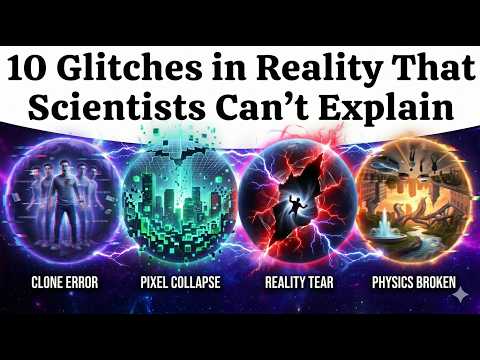
The video above counts down ten anomalies of its own; six of them don't sit on the explicit list above, but each is reproducible, peer-reviewed physics worth naming in passing. They strengthen, rather than duplicate, what the ten entries already establish.
- Retrocausality · the delayed-choice experiment Wheeler 1978, run in Paris 2007, extended at ANU in 2019. A photon's behavior at a point in the past is determined by a measurement choice made in the future. The future reaches backward and rewrites what already happened.
- Quantum tunneling Particles cross barriers they classically cannot cross. The mechanism powers the sun (proton-proton fusion at temperatures a factor of 1,000 too low to overcome electromagnetic repulsion), every alpha decay in Earth's crust, and every transistor in the device you are reading this on.
- Fine-tuning · the 26 constants Paul Davies' probability calculation for the 26 fundamental constants falling into the life-permitting range; Roger Penrose's 1 in 1010123 for the Big Bang's initial low-entropy state. Numbers without physical meaning. The simulation page treats these as parameter settings; see there.
- Vacuum energy · the 10120 discrepancy Quantum field theory predicts a vacuum energy density 10120 times larger than what is observed. If the prediction were correct, the universe would have been destroyed in the first fraction of a second after the Big Bang. The most accurate theory in science predicts a value that makes reality impossible. Reality exists anyway.
- Pilot waves · Couder & Fort 2006 Oil droplets bouncing on a vibrating fluid surface reproduce double-slit interference, tunneling, and quantized orbits — a classical system with no quantum mechanics imitating every strange quantum result. Quantum mechanics may be the shadow of a deeper deterministic reality (de Broglie 1927, Bohm 1952).
- Quantum biology Photosynthesis (Fleming/Berkeley 2007) and the European robin's magnetic compass (Hiscock 2016) both use quantum coherence at body temperature in warm wet tissue where coherence should not survive for more than femtoseconds. Either we are wrong about decoherence or evolution independently discovered how to maintain quantum hardware in conditions physics says are impossible.
- The hard problem of consciousness Every other entry is a glitch in the physical world. This one is different — consciousness is not a glitch in the universe; it is the glitch in the observer. The 2023 Cogitate adversarial collaboration tested the two leading theories (IIT and GNW) head to head; neither survived the data. After thirty years of focused work, we are not closer to an answer. We may be further.
In the trilogy
Where the books touch each glitch
Anima's twenty-four-year edge-case archive sits squarely on top of the observer effect and the measurement problem. The patients who recover under conditions no neurological model permits — Mary Parker's NDE under prolonged cerebral hypoxia, Lucía Reyes's prenatal memories, Mr. Martínez's terminal lucidity — each is a clinical instance of the explanatory gap.
Numen takes entanglement, the observer effect, and the receiver model as its argumentative ground. The fractal triangle José leaves for Alex is, in the books' geometry, the surface form of an underlying pattern made visible. Alma the hybrid consciousness instantiates the same question the CMB anomalies pose: what is the signal underneath the noise?
Limen integrates all ten. The compendium's argument is that the convergence — Faggin's three irreducible properties, the augmented chord's mathematical structure, the receiver model of the body, the architecture of the field — is the only frame in which these ten glitches stop looking like separate scandals and start looking like one description of the same architecture seen from ten angles.
Fragile Light takes entanglement and the observer effect into a political and ethical dimension. The alien intelligence Kiran Sākshī, mirroring Luz across the distance between stars, is entanglement written into character — the same architecture as glitch #2 but lived out at the scale of two minds recognizing each other across the gap, with no signal in between. Luz does not believe the world is constructed; she believes a deeper structure runs reality, and that in that structure consciousness and free choice are not emergent epiphenomena but fundamental properties. Her voluntarist wager — to act with conviction inside an architecture she has glimpsed but cannot prove — is the political form of glitch #7's observer effect: observation is causal, the observer's choice is part of what the universe permits to be real, and refusing to choose is itself a choice that lets the choice be made for one. The novel is what philosophical voluntarism looks like when the metaphysics is taken seriously rather than waved away.
Sources & further reading
- Aspect, A., Grangier, P., Roger, G. · Experimental Tests of Realistic Local Theories via Bell's Theorem, Physical Review Letters 47, 460 (1981). Plus Aspect's 2022 Nobel lecture.
- Yin, J. et al. · Satellite-based entanglement distribution over 1200 kilometres, Science 356, 1140 (2017).
- Hafele, J. C., Keating, R. E. · Around-the-World Atomic Clocks: Observed Relativistic Time Gains, Science 177, 168 (1972). The flying-clock confirmation of time dilation.
- Ashby, N. · Relativity in the Global Positioning System, Living Reviews in Relativity 6, 1 (2003). The GPS engineering case.
- Clowe, D. et al. · A Direct Empirical Proof of the Existence of Dark Matter, Astrophysical Journal Letters 648, L109 (2006). The Bullet Cluster paper.
- Bostrom, N. · Are We Living in a Computer Simulation?, The Philosophical Quarterly 53, 243 (2003). The trilemma.
- Wheeler, J. A. · Information, Physics, Quantum: The Search for Links (1989). "It from bit."
- Planck Collaboration · Planck 2018 results. VII. Isotropy and statistics of the CMB, Astronomy & Astrophysics 641, A7 (2020). The CMB anomaly catalog.
- Hawking, S. W. · Breakdown of Predictability in Gravitational Collapse, Physical Review D 14, 2460 (1976). The information paradox proper.
- Penington, G., Shenker, S. H., Stanford, D., Yang, Z. · Replica wormholes and the entropy of Hawking radiation, JHEP 03 (2020) 205. The island formula.
- Abbott, B. P. et al. (LIGO Scientific Collaboration) · Observation of Gravitational Waves from a Binary Black Hole Merger, Physical Review Letters 116, 061102 (2016).
- Schacter, D. L. · The Seven Sins of Memory, Houghton Mifflin (2001). The cognitive-science framing of constructive memory underlying the Mandela effect.
Want the unifying argument? Read The Simulation Hypothesis · The Evidence →