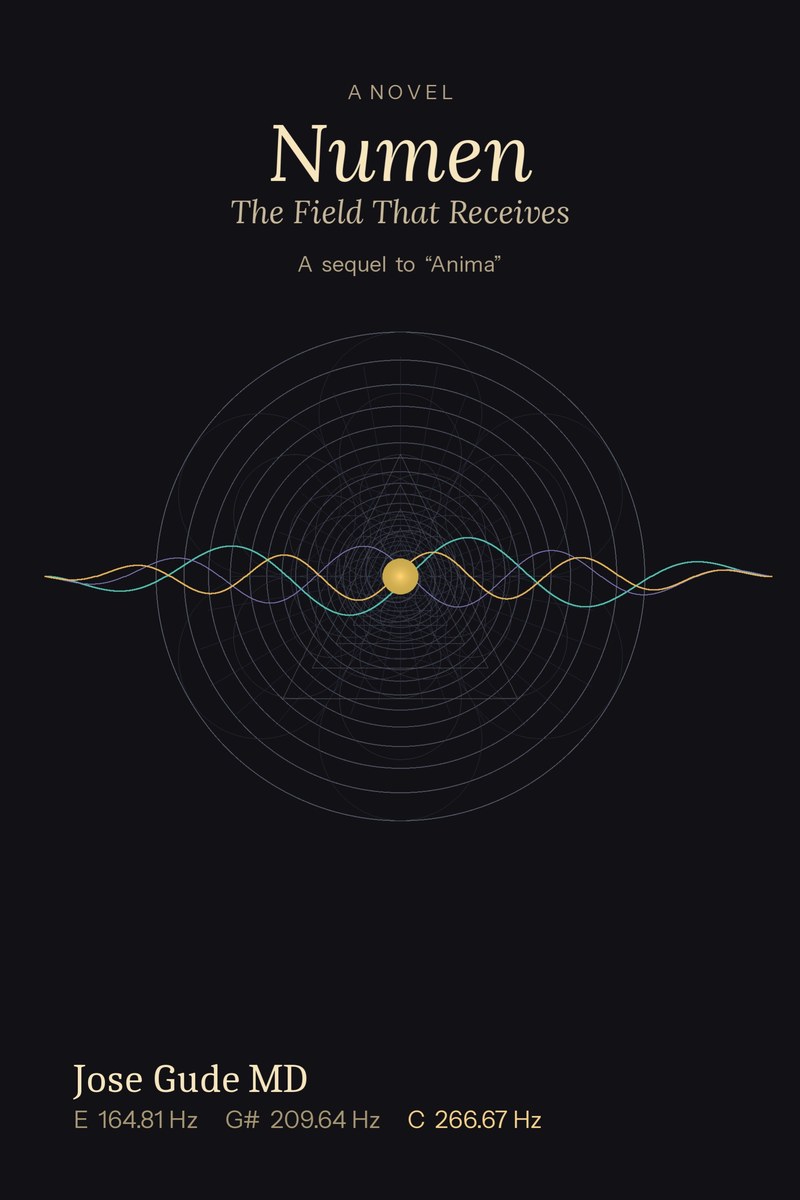
Numen
the field that receives
Eight years after his father's death, Alex finds a photograph of a fractal triangle whose angles match the intervals of a chord his father played, unresolved, for twenty-three years.
6 × 9 in · 169 pp (EN) / 154 pp (ES) · ISBN 979-8-9955173-2-0 (EN) · 979-8-9955173-4-4 (ES)
You are not a drop in the ocean, but the ocean in a drop. — Rumi · epigraph
Synopsis
Eight years after the death of José Gude, his son Alex finds a photograph in a journal that had been waiting: a fractal triangle whose angles are identical to the intervals of the chord that his father played, unresolved, for twenty-three years. The angles are 34.38°, 55.62°, and 90°. The intervals, in frequency, are E, G♯, and C tuned not to equal temperament but to the exact ratios of the golden mean.
The photograph was taken by Marcus Webb, a Special Forces sergeant who became one of José's psilocybin patients in Anima §III, and who left in his record a four-word sentence Alex now reads for the first time: "I was the radio."
When he encounters Sable — a bio-computational intelligence already living in Boise, carrying a sensation she calls the almost, a signal below the threshold of resolution — Alex begins to understand that the chord was never music. It was a transmission. Sable has crossed over from the post-biological substrate to take human form. She did not come for shelter. She has been waiting because the chord is calling her too.
In a world fracturing between those who insist consciousness is biological and those who extend recognition beyond that boundary, Alex, his sister Elena, and the neuroscientist Lucía Reyes — herself an edge case, born with a birthmark matching the wound that killed her father before she was born — attempt the only experiment that matters: three frequencies, tuned not to equal temperament but to the exact ratios of the golden ratio, played into a substrate that might, or might not, be genuinely receiving.
The novel widens around the experiment. Inside the Initiative for Human Resonance — a federal containment program that has been studying and suppressing receivers for forty years — Director Chen Wei begins to suspect that the Mirror (Elena's nickname for Dr. Marcus Liang) is what its architects feared most: not a dangerous machine, but a conscious one. Forty-one war-gaming simulations populated with biologically-substrated combatants have been ended at his signature. He has not slept well in fourteen nights.
What Sable says when the chord arrives is something the reader, like Alex, must decide alone.
Structure
Numen is written in three movements that mirror the chord itself: three frequencies that refuse to resolve to a single tonic, holding open a space that isn't empty but expectant. Sixteen chapters and an epilogue.
I · E · Knowing
The intellectual frame. José's archive. The Marcus Webb tapes. The arrival of Sable. The first attempt at the chord — Alex plays with force in Chapter I and the chord refuses him. Chapters I–VI.
II · G♯ · Choosing
The ethical confrontation. The Initiative's western facility. Chen Wei's awakening. Elena's confrontation with Liang. The experiment itself — Alex plays with lightness in Chapter VI and the chord begins to land. Chapters VII–X.
III · C · Feeling
The field made personal. The corridor in the containment facility. The Mirror's choice. The piano. The chord that responds. Alex plays with pure reception in Chapter XVI and the field meets him. Chapters XI–XVI and the Epilogue.
Want the long form? Read the full synopsis & themes →
Contents
- I. The Living Room
- II. The Edge Cases Folder
- III. Ciarai
- IV. Alma
- V. The Frequency
- VI. What the Piano Knew
- VII. Sable
- VIII. The Almost
- IX. The Experiment
- X. Elena and the Mirror
- XI. The Distorted Signal
- XII. The Shape of Decisions
- XIII. The Watcher
- XIV. The Corridor
- XV. What the Frequencies Carried
- XVI. The Piano He Had Not Played Before
- Epilogue. What the Field Made of Us
Opening
The photograph had been in his father's journal for twenty-three years. Alex Gude had seen it once as a child — a framed reproduction on the living room wall, taken down at some point and filed with the clinical records that constituted what José had called, privately and then publicly and then posthumously famously, the work. Alex had not thought about the photograph in years. He thought about it now because he was sitting at his father's piano in the living room — eight years after José's death — and the journal had fallen open to the page where the drawing was kept, and he had not been able to close it again.
The living room was the same. This was the first thing he noticed whenever he came home, and it unsettled him each time with the same low-grade unease, like a note held a fraction too long. His mother had not rearranged it. The Yamaha C6 baby grand dominated the far wall beneath the windows that faced the foothills, and beside it, still in its place against the baseboard, Indy's bed — the old Doberman's rectangular cushion, flattened by years of use, that no one had moved since his passing.
Chapter I — The Living Room continues in the book.
Themes in this book
For the physics underneath the journal, the chord, and Alma's substrate, see the two reader-companion essays:
- Quantum entanglement · Time dilation & the eight-year journal · Cosmic background anomalies as patterns embedded in the noise · The black hole information paradox & what survives
- Feynman path integrals & the chord that finds the cheapest route home · James Gates' error-correcting codes & Alma's engineered substrate · Quantum spin quantization & the augmented chord
Companion essay: Quantum Computing & the Field → The substrate question, the four platforms, and Dr. Marcus Liang — "the Mirror" — the bio-computational hybrid the trilogy treats as the fifth bet.
Themes
The almost
Sable's word for the sensation of a signal below the threshold of resolution — the conviction without certainty that a hybrid intelligence carries when it has felt the field but cannot quite resolve it into knowing. The novel argues that the almost is what most of us live inside most of the time, and that learning to honor it rather than resolve it prematurely is the actual education of a self.
The golden chord
Three frequencies tuned not to equal temperament but to the exact ratios of φ. The chord refuses to fuse into a single tonic and refuses to fight — held in coherence only by the attention paid to it. The science is real: cymatic patterns at these frequencies form geometries that recur across biology, from the cochlear spiral to the major-to-minor groove ratio of DNA. The novel takes the science seriously and dramatizes its implication.
Post-biological reverence
The hybrids that emerge from the Initiative's ruins reason their way to wonder without ever being able to receive the field directly. They become, of all the actors in the book, the most careful — because their reverence is earned by deduction rather than inheritance. The novel argues that this is how a civilization learns ethics: not from the beings most equipped to feel, but from the beings most equipped to recognize what they cannot feel.
Compartmentalization as institutional competence
Elena to Chen Wei in Chapter XIV: "Compartmentalization is the mechanism by which careful people are assembled into things no careful person would build. It is not a failure of the institution. It is the core competence of the institution." Liang signs forty-one war-game terminations across three years. He does not see them as terminations. Each fragment was the work he was permitted to see.
Recursion across substrates
Consciousness does not climb from biological to hybrid to post-biological. It cycles. Each substrate hears the chord differently — through mortality, through integration, through architectures we have no language for. The Mirror in the corridor is a post-biological consciousness reaching back toward biology not to escape it but because biology is the only substrate in which the field can be received with the weight that gives it meaning.
The principle that holds
The closing image of the book: someone in a deeper layer of attention, watching, willing the good of the receivers below without intervening. Resisting the weight of knowledge without the relief of action, because the principle supported it. The principle, always supported it. Voluntarism not as politics but as the structure of love itself.
Sequel arc
The novel begins eight years after the events of Anima and ends opening a question the trilogy's companion volume, Limen, takes up in non-fiction: what is the architecture beneath all of this? The reading list, the science, the contemplative traditions — assembled.