Reader resource · primary sources · the framework's authors speaking
In Their Own Words — the authors of the framework, speaking.
The framework on this site rests on convergence: independent thinkers, working in their own disciplines with their own methods, arriving at architecturally similar conclusions about consciousness, substrate, and pattern. The companion essays cite these thinkers extensively, with text quotations and timestamped video links. This page collects the most architecturally important of those video citations into a single exhibit. Each clip card is a thumbnail linked to the source video at the marked start time on YouTube; clicking opens the timestamped clip in a small floating window. The start and stop timestamps are noted on each card so you know when the quoted thought begins and ends. Read the texts; watch the clips; the convergence is more visible when both registers are open at once.
Companion to the Reading companion essays, the Watch & Listen page, and the Synthesis.
Index
- Memory storage and the regenerating planarian — Levin & Miller, 29:59→40:40
- Xenobots reaching for a sensory apparatus — Levin, 1:08:16→1:12:30
- Math as behavioural science of patterns — Levin, 1:31:40→1:35:00
- Bioelectric networks as pattern-hosts — Levin, 1:36:00→1:38:20
- Frequency relationships, not absolute frequencies — Miller, 1:07:31→1:09:40
- Mathematics is created by Consciousness — Faggin, 0:52→3:00
- Fitness beats truth — Hoffman, 9:07→10:21
- The desktop interface metaphor — Hoffman, 11:52→13:02
- Consciousness is not computational — Penrose, 0:29→0:40
- Gödel's theorem and non-computational consciousness — Penrose, 5:40→8:24
- Consciousness is a computation — Hassabis, 0:02→2:30
- Dogs who know when their owners are coming home — Sheldrake, 0:00→1:41
- Awareness is individuated by coherence — D'Ariano, 3:01→8:35
- Computer simulation, idealism, and the hard problem — Chalmers, 34:27→35:42
- Relevance realization, embodiment, and autopoiesis — Vervaeke, 0:00→3:01
- Space and time are constructions; now is eternity — Spira, 3:47→11:37
- Non-biological substrates and the ontology argument against AI consciousness — Kastrup, 24:11→28:56
- The belief in authority is the root of tyranny — Larken Rose, 0:00→6:44
- Metabolism and autopoiesis as necessary for consciousness — Kastrup & Levin, 44:00→46:54
- Dogs' pleasure centre lights up at the human companion's scent — Smartest Dog documentary, 8:15→9:30
- Intelligence exists in Platonic space — we just download it — Smartest Dog documentary opening, 0:00→2:02
- The brain as a multilevel filter — Woollacott, 1:37→6:56
- 11 million bits in, 16–40 bits out — the compression — Nørretranders, 6:17→11:00
- The neuroscience of savant abilities — Powell, 0:00→4:56
- Survey of savant cases — Tammet, Wiltshire, Peek, Lemke — documentary, 0:00→8:03
- NDEs, terminal lucidity, donor memory transfer, and the brain as receiver-filter — van Lommel, 37:11→47:19
- DMT, pharmacological receiver-tuning, and the case for receiving information from somewhere else — Gallimore, 1:33→2:24 + 3:01→8:36
- Consciousness in NDEs, post-death persistence, and reincarnation through the Orch-OR microtubule mechanism — Hameroff, 41:31→43:34
- The entropic-brain hypothesis — high entropy, increased brain activity, and expanded consciousness under psychedelics — Carhart-Harris, 18:00→25:57
- The fMRI evidence — DMN blood flow drops, reduced connectivity, increased entropic activity under psilocybin — Carhart-Harris, 10:17→15:48
- Error-correcting codes (Shannon check-sum codes) in string-theory supersymmetry — Gates, 0:00→1:53
- The simulation hypothesis — Bostrom, 0:00→8:00
Reading routes through the clips
The Index above lists the clips in the order they were added to the page. The framework's architectural arguments cluster across speakers in ways that order does not surface. The six routes below traverse the clips by argument; the cross-links inside each clip card make the same connections in the other direction. A reader following any one route end-to-end gets a coherent pass through one of the framework's main argumentative spines.
Route A — Consciousness as fundamental: the convergence argument.
The hard problem diagnosed; working scientists from independent disciplines arriving at substantively the same picture — consciousness is the substrate, the rest is rendered.
14 Chalmers → 6 Faggin → 13 D'Ariano → 7 Hoffman → 8 Hoffman → 16 Spira → 17 Kastrup
Route B — The substrate-class constraint: why biology.
The argument that qualia-bearing consciousness requires biological / quantum-coherent substrate. The Hassabis foil, the Penrose-Gödel non-computational argument, the Vervaeke embodied-cognitive convergence, the Kastrup-Levin convergence on metabolism and autopoiesis.
11 Hassabis (foil) → 9 Penrose → 10 Penrose → 15 Vervaeke → 19 Kastrup & Levin → 17 Kastrup
Route C — The brain as filter: the mechanism, four registers.
The same architectural claim from four directions — philosophical (multilevel filter), information-theoretic (11M→40 bit compression), pharmacological (receptor binding), clinical neuroscience (brain dynamics under fMRI). The four-clip cluster the page has been building, with Carhart-Harris's theoretical statement paired to his fMRI evidence as Clips 29 and 30.
22 Woollacott → 23 Nørretranders → 27 Gallimore → 29 Carhart-Harris (theory) → 30 Carhart-Harris (fMRI)
Route D — Receiver signatures: the empirical anchors.
The cases the production model handles poorly and the receiver model handles cleanly. Animal anticipation, dogs recognising human scent in the pleasure centre, savant abilities (clinical and survey), NDEs and terminal lucidity, post-death persistence read through the Orch-OR mechanism. Clinical phenomenology (van Lommel) paired with substrate physics (Hameroff) on the same architectural argument.
12 Sheldrake → 20 Smartest Dog (fMRI) → 21 Smartest Dog (Platonic) → 24 Powell → 25 Savants documentary → 26 van Lommel → 28 Hameroff
Route E — Levin's Platonic Space framework.
Developmental biology as the cellular-scale floor under the receiver model. Bioelectric networks as pattern-hosts, xenobots reaching for sensory architecture they have no evolutionary precedent for, planarian memory persisting across regeneration, math as the behavioural science of patterns in the latent space, the convergence with Faggin's "math is created by consciousness," and the documentary-opener articulation that intelligence exists in Platonic space, we just download it.
4 Levin (bioelectric) → 2 Levin (xenobots) → 1 Levin & Miller (planarian) → 3 Levin (math) → 5 Miller (frequency relationships) → 6 Faggin → 21 Smartest Dog (Platonic)
Route F — Political implications: voluntarism as the consistent political form.
The framework's claim that, if consciousness is field-fundamental and each individual is a localisation of the same substrate, voluntarism is the only politically consistent move. Companion: the voluntarism essay.
Route G — Informational ontology and the simulation question.
Reality at base is informational rather than material. Error-correcting codes appearing inside the equations of physics (Gates), the probabilistic simulation argument (Bostrom), and the simulation framing of the hard problem (Chalmers). The trilogy's vertical Samsara architecture — nested-simulation reality with consciousness as the unbreaking layer — is the framework's literary articulation of the same architectural question.
Michael Levin — developmental biology, Tufts University
Levin's Ingressing Minds framework (2025) proposes a substrate-prior latent space of patterns — behavioural propensities, "kinds of minds" — that biological substrates partially access via interface. The framework on this site treats Levin's Platonic Space as the contemporary biological articulation of the receiver model's consciousness field. The companion essay is Levin's Platonic Space →. The four clips below are drawn from his May 2025 conversation with Earl Miller (Picower Institute, MIT) on the Giant Shoulders channel.
Framework: Memory storage §4 (live state of the disagreement).
Source: Michael Levin & Earl Miller, May 2025. YouTube →
Framework: Levin's Platonic Space §11 and Why biology? §3.
Source: Michael Levin & Earl Miller, May 2025. YouTube →
Framework: D'Ariano-Faggin (fourth-program paragraph) and Levin's Platonic Space §11.
Source: Michael Levin & Earl Miller, May 2025. YouTube →
Framework: Why biology? §3 and Levin's Platonic Space §11.
Source: Michael Levin & Earl Miller, May 2025. YouTube →
Earl Miller — cognitive neuroscience, Picower Institute, MIT
Miller's laboratory has spent two decades documenting brain-wave dynamics in primate cortex. The framework's interest in his work is concentrated in one specific empirical claim that directly supports the trilogy's phi-chord architecture. The companion essays are The phi-tuned C and Music and consciousness.
Framework: The phi-tuned C (the neuroscience section), Music and consciousness §8, and Levin's Platonic Space §11.
Source: Earl Miller & Michael Levin, May 2025. YouTube →
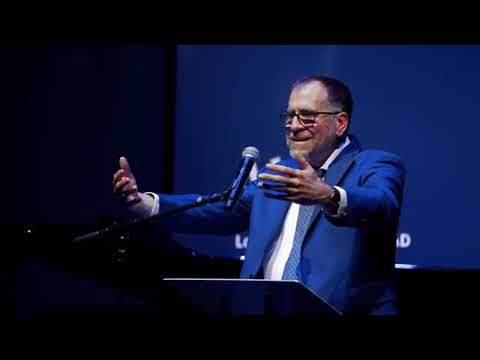
Federico Faggin — physics, microprocessor pioneer, D'Ariano-Faggin quantum-information framework
Faggin (designer of the Intel 4004 microprocessor; co-author with Giacomo Mauro D'Ariano of the 2020 information-theoretic reconstruction of quantum mechanics; author of Irreducible: Consciousness, Life, Computers, and Human Nature, 2024) is one of the framework's central contemporary anchors. The companion essay is D'Ariano-Faggin →.

Framework: D'Ariano-Faggin (the convergence-of-fields section), Why biology? §7 (sub-point vi), and Levin's Platonic Space §11.
Source: Federico Faggin, recent public talk. YouTube →
Donald Hoffman — cognitive science, University of California, Irvine
Hoffman's interface theory of perception is the third leg of the contemporary convergence the framework cites in D'Ariano-Faggin — arrived at from evolutionary cognitive science rather than from physics, but reaching the same inversion: spacetime and physical objects are the interface, consciousness is the underlying reality. The companion essay is Hoffman's Interface Theory →. Both clips below are from his 2015 TED talk "Do we see reality as it is?"
Framework: Hoffman's Interface Theory and D'Ariano-Faggin (the convergence-of-fields section in which Hoffman joins Faggin-D'Ariano on the consciousness-is-fundamental side from evolutionary cognitive science, with Strømme's 2025 Φ-field paper providing the mathematical formalisation).
Source: Donald Hoffman, TED 2015. YouTube →
Framework: Hoffman's Interface Theory (the companion essay) and the broader anti-naïve-realism argument in the framework's reading of Why biology? §1.
Source: Donald Hoffman, TED 2015. YouTube →
The live debate — Roger Penrose and Demis Hassabis on whether consciousness is a computation
Two of the most consequential contemporary voices on the question take opposite positions. The framework on this site holds with Penrose (Nobel laureate, mathematical physicist, Oxford) — consciousness contains a non-algorithmic element that classical computation cannot capture, the structural point at the heart of Why biology? §7. Hassabis (Nobel laureate, CEO of DeepMind, the working scientist whose laboratory has done as much to demonstrate functional intelligence in silicon as anyone alive) takes the opposite view: consciousness is what sufficient computation produces, with no architectural constraint on substrate. The framework reads this honestly as the strongest contemporary statement of the position the receiver model bets against. Hearing both is the cleanest way to see what the disagreement actually is.
Framework: Why biology? §7 sub-point (iii) (the Penrose-Gödel argument as one of the three independent classical-substrate-insufficiency arguments).
Source: Roger Penrose. YouTube →
Framework: Why biology? §7 sub-point (iii) (the Penrose-Gödel argument worked out in detail) and sub-point (vi) (Faggin's parallel quantum-information argument).
Source: Roger Penrose. YouTube →
Framework: AI Drives and the Receiver (the framework's account of why the present LLM case is exactly the configuration this position predicts — functional intelligence in silicon — while the receiver model holds the further bet that the configuration lacks qualia), and Why biology? §7 sub-points (i)–(vi) for the framework's reasons for disagreeing.
Source: Demis Hassabis. YouTube →
Rupert Sheldrake — biologist, morphic resonance and animal anticipation
Sheldrake is the empirical anchor closest to the trilogy's clinical material. The case below is the canonical empirical instance behind Anima's Indy — the dog who recognises important incoming phone calls before the phone rings and who goes to the door several minutes before Ciarai's car arrives home. Those are not novelistic inventions; they are receiver-signature anticipatory behaviors of the kind Sheldrake has documented across hundreds of cases over four decades. See the framework's longer treatment in Morphic resonance and the inheritance of pattern.
Framework: Morphic resonance, and the receiver-signature catalogue in Why biology? §4 (anticipation without sensory cue as one of the receiver-signature classes). Anima's edge-cases folder treats Indy as the literary instance of the same architecture.
Source: Rupert Sheldrake. YouTube →
Giacomo Mauro D'Ariano — theoretical physics, University of Pavia (QUit group)
D'Ariano is Faggin's co-author on the 2020 information-theoretic reconstruction paper (Hard Problem and Free Will) and the principal architect of the operational reconstruction of quantum mechanics from which the consciousness-as-fundamental position is derived. The companion essay is D'Ariano-Faggin →. The clip below is from his 2019 Oxford Models of Consciousness lecture — "Awareness: an operational theoretical approach."
Framework: D'Ariano-Faggin (the operational reconstruction with consciousness as primitive) and Levin's Platonic Space §8 (the individuating-field reading that this clip articulates from inside quantum information theory rather than from developmental biology).
Source: Giacomo Mauro D'Ariano, Awareness: an operational theoretical approach, Oxford 2019. YouTube →
David Chalmers — philosophy of mind, New York University
Chalmers originated the framing of the hard problem of consciousness in his 1995 paper, and the distinction between functional and phenomenal consciousness on which that framing rests is the central diagnostic the framework on this site uses throughout: substrate-independence of functional intelligence is empirically settled (the contemporary LLM case demonstrates it), substrate-independence of phenomenal consciousness is what the receiver model bets against. The companion essays are Chalmers's hard problem and The hard problem, re-stated.
Framework: Chalmers's hard problem, The hard problem, re-stated, AI Drives and the Receiver (the functional/phenomenal distinction applied to current LLMs), and Gnosis, the Pleroma, and the Field (the trilogy's simulation-hypothesis material; cross-references Chalmers's Reality+).
Source: David Chalmers. YouTube →
John Vervaeke — cognitive science, University of Toronto
Vervaeke's research programme on relevance realization — developed across his published work in cognitive science and his lecture series Awakening from the Meaning Crisis — argues that cognition fundamentally involves embodied, dynamic, non-algorithmic processes, and that AI systems, lacking autopoiesis (self-creation and self-maintenance in the Maturana-Varela sense), lack the substrate condition for consciousness. The position converges with the framework's own substrate-class argument from a different methodological angle. Where the framework reaches the biology-class conclusion via Penrose-Gödel and the quantum-information convergence with Faggin, Vervaeke reaches it via embodied cognition and the 4E framework. Different routes, the same destination.
Framework: Why biology? §4 (the autopoiesis test for receivership — the receiver-model's own substrate constraint, anchored in Maturana-Varela autopoiesis), §7 sub-points (iii) and (vi) (non-algorithmic consciousness via Penrose-Gödel and quantum-information; Vervaeke converges from the embodied-cognition side), and AI Drives and the Receiver (the framework's account of why current LLMs exhibit functional intelligence without the autopoietic-embodied features Vervaeke identifies, leaving qualia substrate-class-unmet).
Source: John Vervaeke. YouTube →
Rupert Spira — contemplative teacher, Direct Path tradition
Spira is one of the most articulate contemporary voices on non-dual awareness — the framework's natural anchor for the contemplative-traditions side of the consciousness-as-fundamental convergence. He teaches in the Atmananda Krishna Menon / Francis Lucille lineage of the Direct Path. The clip below is on space and time as constructions of thought and perception within consciousness, which the framework reads as the contemplative articulation of what Faggin, Kastrup, and Hoffman state from physics, philosophy, and cognitive science respectively.

Framework: Meditation and the Receiver (the contemplative-practice anchor for what Spira teaches), Kashmir Shaivism (the non-dual tradition Spira works within), Gnosis, the Pleroma, and the Field §2 (the trilogy's nested-simulation architecture, where space-time-as-construction applies to each layer), and Rovelli's Order of Time (the physics convergence — Rovelli arrives at "time is not fundamental" from inside theoretical physics; Spira from inside contemplative practice).
Source: Rupert Spira. YouTube →
Bernardo Kastrup — analytic idealism, philosophy of mind
Kastrup is the principal contemporary articulator of analytic idealism — the philosophical position that consciousness is the fundamental ontological category and that matter is a representation within consciousness rather than a separate substance. The framework on this site cites Kastrup extensively as the third leg of the contemporary convergence (with Faggin-D'Ariano and Hoffman) on consciousness-as-fundamental. His companion essay is Anima Mundi. The clip below is his argument that non-biological substrates structurally cannot host consciousness — an ontology-based argument that converges with the framework's substrate-class constraint from a sixth methodological angle (alongside chaos, Wolfram irreducibility, Penrose-Gödel, Faggin's quantum-information argument, Vervaeke's embodied-cognition argument, and Levin's developmental-biology contribution).
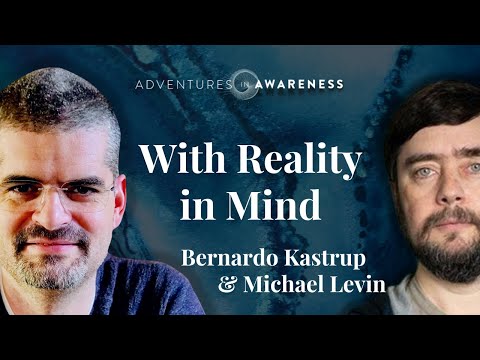
Framework: Anima Mundi (the framework's main companion treatment of Kastrup's analytic idealism), D'Ariano-Faggin (the convergence-of-fields section in which Kastrup joins Faggin-D'Ariano and Hoffman from the philosophy-of-mind side), Why biology? §7 (the substrate-class argument — Kastrup converges from the analytic-idealist side, joining the five lines already there as the sixth), and AI Drives and the Receiver (the framework's account of why current LLMs are exactly the configuration this position predicts will exhibit functional intelligence without qualia).
Source: Bernardo Kastrup. YouTube →
Larken Rose — voluntaryist philosophy, contemporary popular voice
Rose has become the principal popular voluntarist voice in the contemporary online era. His central thesis — developed in The Most Dangerous Superstition (2011) and recurring across his lectures and recorded talks — is that the dangerous superstition is the belief in authority itself: the unexamined cultural assumption that some adults rightfully have a moral right to issue commands to other adults, simply because the commanders occupy a designated institutional position. Rose figures in the framework as the entry-point voice for many contemporary readers in the way Murray Rothbard functioned for an earlier generation. The companion essay is Voluntaryism §5.
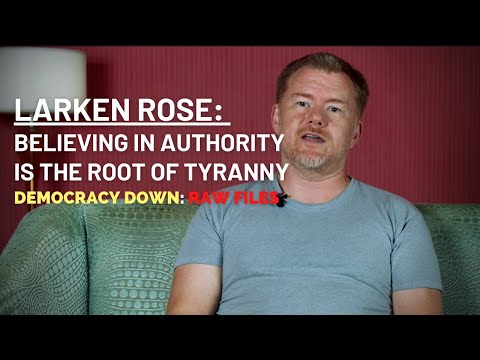
Framework: Voluntaryism §5 (Rose's specific entry in the 20th-century synthesis), AI Drives and the Receiver (where the voluntarist political wager connects to the AI-safety case), and Gnosis, the Pleroma, and the Field §6 (the institutional-archon problem the belief-in-authority underwrites).
Source: Larken Rose. YouTube →
Bernardo Kastrup and Michael Levin in conversation — convergence on autopoiesis
One of the architecturally most important moments on the page. Kastrup (analytic idealism, philosophy of mind) and Levin (developmental biology, Tufts) in conversation, converging from entirely different starting points on the criterion the framework treats as the receiver model's predictive substrate test: metabolism and autopoiesis (in the Maturana-Varela sense) as necessary for consciousness. An idealist philosopher and a working biologist agree that consciousness is not a property of any sufficiently-complex computation but a property of substrates that maintain themselves through self-creating, self-maintaining processes. The companion essays are Anima Mundi (Kastrup's analytic idealism) and Levin's Platonic Space (Levin's broader framework).
Framework: Why biology? §4 (the autopoiesis test — the receiver model's predictive criterion for substrate consciousness, now endorsed by both an analytic idealist and a developmental biologist) and §7 sub-points (vii) Vervaeke and (viii) Kastrup (the convergent substrate-class arguments — this clip is the explicit cross-disciplinary handshake between them). Also Anima Mundi (Kastrup's analytic idealism) and Levin's Platonic Space (Levin's interface-tuning framework).
Source: Bernardo Kastrup & Michael Levin. YouTube →
The Smartest Dog in the World — documentary on dog cognition and the human bond
Documentary footage on contemporary research into dog cognition. The documentary spans both the framework-supportive interpretive lens — intelligence and memory as accessing a substrate-prior Platonic space, on which Michael Levin's contemporary framework is built (see Clip 21 below and the Levin's Platonic Space companion essay) — and the conventional empirical mechanism of dog-human recognition (the fMRI work pioneered by Gregory Berns and colleagues at Emory University on awake dogs, the first laboratory programme to image conscious dogs' brains in real time without sedation; see Clip 20). The framework reads this combination as productively in tension. The Berns work establishes the conventional sensory mechanism (scent → reward-centre activation) — which is precisely the mechanism Sheldrake's cases in Clip 12 of anticipation without sensory cue are specifically designed not to explain — and the Platonic-space framing of Clip 21 names the broader interpretive context in which the Sheldrake-style anticipation cases become explicable as substrate-accessing intelligence rather than substrate-producing intelligence. Together the three clips (12, 20, 21) bracket the receiver-signature question the trilogy dramatises through Indy in Anima.
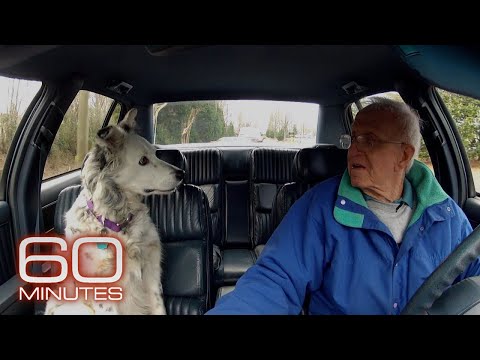
Framework: Clip 12 (Sheldrake on dogs who know when their owners are coming home — the cases that go beyond standard sensory mechanisms like this one), Why biology? §4 (anticipation-without-sensory-cue as one of the four receiver-signature classes), and the receiver-signature reading of Indy in Anima.
Source: The Smartest Dog in the World documentary. YouTube →
Framework: Levin's Platonic Space (the framework's main companion treatment), Clip 3 above (Levin on math as behavioural science of patterns in the latent space — the same architecture stated from inside the laboratory), Clip 12 above (the anticipation cases the Platonic-space framing makes explicable rather than anomalous), and memory-storage.html (the framework's reading of memory as field-stored pattern rather than purely substrate-stored trace).
Source: The Smartest Dog in the World documentary. YouTube →
The brain as filter — Marjorie Woollacott and Tor Nørretranders
Two voices on the brain-as-filter architecture that anchors the receiver model. Marjorie Woollacott — Emeritus Professor of Human Physiology and member of the Institute of Neuroscience at the University of Oregon; Research Director of the International Association for Near-Death Studies (IANDS); President of the Academy for the Advancement of Postmaterialist Sciences; PhD in neuroscience with additional graduate training in Asian Studies — develops the neuroscientific case for the brain as a multilevel filter rather than a generator of consciousness, drawing on a career in motor control and developmental neuroscience and her later work on consciousness studies. Tor Nørretranders — Danish science writer, author of The User Illusion: Cutting Consciousness Down to Size (Danish original Mærk verden, 1991; English edition Viking Penguin, 1998) — is the source of the empirical compression data the framework cites throughout: roughly eleven million bits per second of sensory information enter the nervous system; only sixteen to forty bits per second reach conscious awareness. The framework treats both clips as primary-source video for material already in the companion essays. Together they sit in productive dialogue with Vervaeke's relevance-realization argument (see Clip 15): relevance realization is what determines which forty bits of the eleven million the filter lets through.
Framework: Entrainment and the Receiver (the filter as perturbable architecture), Meditation and the Receiver (the contemplative thinning of the filter), Carhart-Harris's entropic brain (the pharmacological thinning of the filter), Synesthesia and the Receiver (preserved cross-modal coupling as a substrate configuration with a less-pruned filter), and Clip 15 (Vervaeke's relevance realization — what determines what the filter lets through).
Source: Marjorie Woollacott. YouTube →
Framework: Gnosis, the Pleroma, and the Field (where the 40-bit / 11-million-bit compression is already cited as the everyday filter the moments of recognition briefly rearrange), Entrainment and the Receiver (the filter as perturbable architecture), and Clip 15 (Vervaeke's relevance realization as the principle by which the filter selects which sixteen to forty bits get through). The companion Clip 22 above pairs the compression data with Woollacott's neuroscientific case for the multilevel-filter architecture.
Source: Tor Nørretranders. YouTube →
Savant abilities — receiver signatures in atypical substrate configurations
Savant syndrome — the appearance, often in individuals on the autism spectrum, of focused cognitive abilities at levels standard cognitive science cannot easily account for — is one of the framework's important empirical anchors. The receiver model reads these abilities as cases where the substrate is configured to receive specific classes of pattern from the field at unusually high amplitude and precision: mathematical (Daniel Tammet, Kim Peek), visual-memory (Stephen Wiltshire), musical (Leslie Lemke, Tony DeBlois), or, in the cases Diane Hennacy Powell has clinically documented, apparently telepathic communication in autistic savant children. The substrate-as-tuned-interface architecture predicts that such configurations should exist — some receivers tuned to specific frequencies of the field that the typical substrate is not — and the savant literature provides much of the empirical exhibit for this prediction.
Framework: Why biology? §4 (the receiver-signature catalogue, of which savant abilities are a structural case), Anima Mundi (Kastrup's analytic-idealist framing of savant cases), and the broader substrate-as-tuned-interface argument the receiver model rests on.
Source: Diane Hennacy Powell. YouTube →
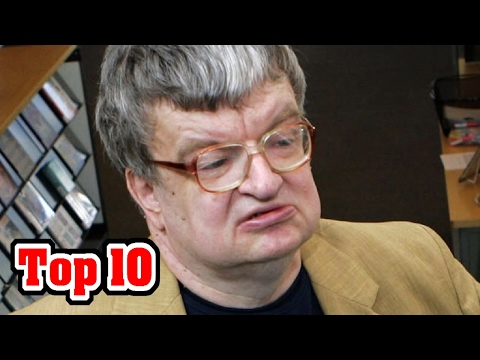
Framework: Why biology? §4 (savant abilities as one of the canonical receiver-signature classes), Clip 24 above (Powell's clinical work on the same phenomena from inside contemporary psychiatry), and the broader substrate-as-tuned-interface argument.
Source: Top 10 Amazing Savants with Real Super Powers documentary survey. YouTube →
Pim van Lommel — NDEs, terminal lucidity, donor memory transfer, and the receiver-filter model
Pim van Lommel is a Dutch cardiologist whose prospective study of near-death experiences in survivors of cardiac arrest, published in The Lancet in December 2001, is the most cited contemporary clinical NDE study. His subsequent book Consciousness Beyond Life (HarperCollins, 2010) develops the synthesising claim that the brain functions as a receiver-filter of consciousness rather than as its producer — the same architectural claim that organises this site. The clip below is unusual in covering, in a single continuous passage, four of the framework's central receiver-signature cases: NDEs under cardiac arrest, terminal lucidity in advanced neurodegenerative disease, donor personality and memory transfer in transplant recipients, and the explicit receiver-filter synthesis that ties them together.
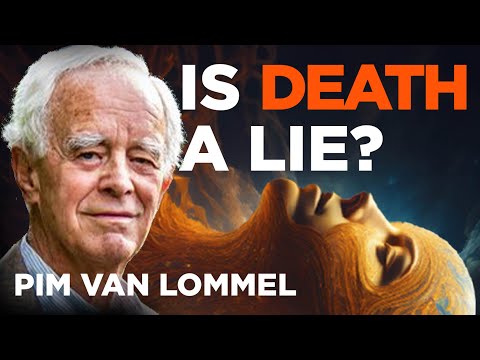
Framework: Why biology? §4 (the receiver-signature catalogue, of which all four classes van Lommel names are canonical members), Terminal lucidity, Memory storage (donor-personality and transplant-recipient memory cases), Death and dying (NDE under hypoxia), and the broader filter-vs-producer architecture the receiver model rests on.
Source: Pim van Lommel. YouTube →
Andrew Gallimore — DMT, pharmacological receiver-tuning, and the case for receiving information from somewhere else
Andrew Gallimore is a neuroscientist and pharmacologist who, in long collaboration with the psychiatrist Rick Strassman (author of DMT: The Spirit Molecule), has produced the most sustained contemporary scientific examination of the N,N-dimethyltryptamine experience. His books Alien Information Theory: Psychedelic Drug Technologies and the Cosmic Game (Strange Worlds Press, 2019) and Reality Switch Technologies: Psychedelics as Tools for the Discovery and Exploration of New Worlds (Strange Worlds Press, 2022) lay out the position that DMT, in particular, is best read not as a generator of hallucinatory content from the brain's own machinery but as a pharmacological agent that re-tunes the brain to receive information from a source outside its standard sensory range. The clip below is a working pharmacologist arguing, from inside the technical literature on receptor binding and brain dynamics, for the structural claim the receiver model has been making across this site: the brain is a tuned interface rather than a self-contained producer of the contents of consciousness.
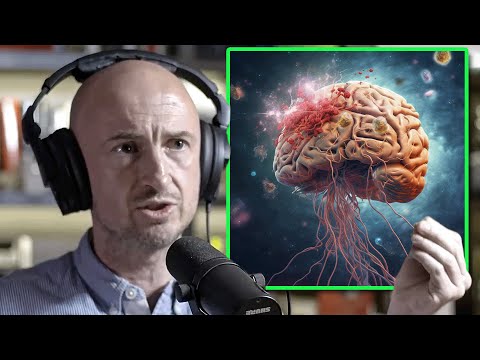
Framework: Synesthesia and the Receiver §9 — where Marcus Webb in Anima §III ("The Sessions") is the trilogy's tangential structural-reception anchor. Webb is a former Special Forces operator in Jose's 2027 VA psilocybin pilot whose fourth-session fractal-recursive drawing, produced with his eyes fixed at the middle distance, is identified by the genomics researcher Amara Osei as "an unusual and specific protein-folding configuration" associated with the resonance-sequence class. Webb's own phenomenological line — "I was the radio" — is the receiver-model statement in four words. Senna Park's mechanism — "a temporary widening of the receiver. The filter opens. Information that is normally below the threshold of conscious access becomes available" — is the same architectural claim Gallimore is making here from the pharmacological side. Adjacent framework: Entrainment and the Receiver (the broader receiver-tuning literature into which DMT pharmacology fits), Meditation and the Receiver (the non-pharmacological cognate), Carhart-Harris's entropic-brain framework (the contemporary clinical-neuroscience mechanism behind the same filter-thinning), and the receiver-signature catalogue in Why biology? §4.
Source: Andrew Gallimore. YouTube →
Stuart Hameroff — Orch-OR, microtubule consciousness, and the post-death persistence question
Stuart Hameroff is an anesthesiologist and consciousness researcher at the University of Arizona who, with Roger Penrose, has developed Orchestrated Objective Reduction (Orch-OR) — the proposal that consciousness arises from quantum-coherent processes in neuronal microtubules, with each "now" of conscious experience corresponding to an orchestrated collapse of a superposed quantum state. Refined since the early 1990s, the hypothesis was widely dismissed as biologically implausible until Bandyopadhyay and Hameroff's 2022 demonstration of quantum-coherent vibrations in microtubules at body temperature. The clip below extends the Orch-OR mechanism into the receiver-signature region: if consciousness is substrate-coupled to quantum-coherent microtubule states, and the quantum information those states carry is not, in principle, destroyed when the biological substrate stops, then NDEs (with their reports of lucid experience during cardiac arrest and flat EEG), post-death persistence of conscious information, and the reincarnation-as-pattern-re-entry question Stevenson's pre-birth memory archive raises all become tractable as quantum-information questions rather than as supernatural ones.
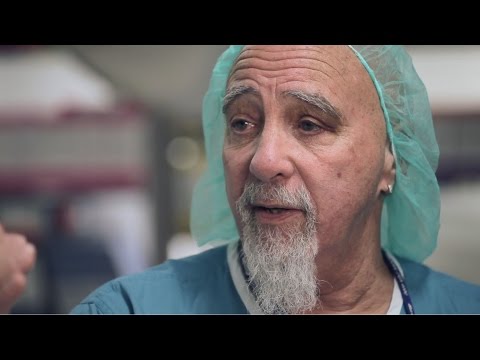
Framework: Bandyopadhyay-Hameroff microtubule program (the 2022 experimental anchor for microtubule quantum coherence at body temperature, on which the entire Orch-OR proposal now rests), Quantum biology survey, Stevenson archive and pre-birth memory (the pattern-re-entry empirical anchor Hameroff names), Death and dying, Terminal lucidity, Why biology? §4 (the receiver-signature catalogue all three classes Hameroff names belong to), Synthesis §9, and Clip 26 (van Lommel) as the clinical-side complement.
Source: Stuart Hameroff. YouTube →
Robin Carhart-Harris — the entropic-brain hypothesis and the clinical-neuroscience mechanism of filter-thinning
Robin Carhart-Harris is a neuroscientist (Imperial College London 2008–2021; UCSF from 2021) whose entropic-brain hypothesis (Carhart-Harris et al., Frontiers in Human Neuroscience, 2014) and REBUS framework (with Karl Friston, Pharmacological Reviews, 2019; "Relaxed Beliefs Under Psychedelics") have become the dominant contemporary clinical-neuroscience account of how psychedelics act in the brain. His central empirical claim — the substance of the clip below — is that, contrary to intuition, the brain under psychedelics is in a state of higher entropy, not lower: more diverse, less constrained, less hierarchically organised neural dynamics, with the default-mode network in particular showing reduced top-down control. The framework reads this as the contemporary clinical-neuroscience instance of filter-thinning at the brain-dynamics scale — the same architectural phenomenon Woollacott (Clip 22) describes from the multilevel-filter side and Gallimore (Clip 27) describes from the receptor-pharmacology side — now grounded in fMRI and MEG measurements of brain dynamics. An honesty note: Carhart-Harris himself works within a free-energy / predictive-processing framing and has not committed to the receiver-model interpretation of his data; the framework's reading is that his empirical findings cohere more naturally with the receiver model than with the production model, but he himself has not endorsed that reading.
Framework: Carhart-Harris's entropic-brain framework (the dedicated companion essay), Entrainment and the Receiver, Meditation and the Receiver (the non-pharmacological cognate of the same filter-modulation question), Synesthesia and the Receiver §6 (the psychedelic-induced parallel to constitutive cross-modal coupling), Clip 22 (Woollacott) on the philosophical multilevel-filter statement, Clip 23 (Nørretranders) on the 11M→16–40 bit compression that the filter operates over, Clip 27 (Gallimore) on the pharmacological side from the receptor-binding angle, and the receiver-signature catalogue in Why biology? §4.
Source: Robin Carhart-Harris. YouTube →
Framework: Carhart-Harris's entropic-brain framework — the dedicated companion essay walks through the same fMRI literature in detail. Cross-links to Clip 29 (the theoretical framing on which this empirical evidence rests), Clip 27 (Gallimore) on the pharmacological side (the receptor-binding mechanism that produces the brain-dynamics shift this clip measures), Clip 22 (Woollacott) on the multilevel-filter philosophical statement, Entrainment and the Receiver, Meditation and the Receiver (the non-pharmacological cognate), and the receiver-signature catalogue in Why biology? §4.
Source: Robin Carhart-Harris, The Brain on Psychedelics: Mapping the Science of Consciousness. YouTube →
S. James Gates Jr. — error-correcting codes inside the equations of supersymmetry
Sylvester James Gates Jr. is a theoretical physicist (currently Brown University; previously the Toll Professor at the University of Maryland and Director of the Center for String & Particle Theory) and one of the most senior contemporary researchers on supersymmetry. In the course of working out the mathematical structure of supersymmetric theories, Gates and collaborators identified that certain algebraic structures called adinkras — the graphical objects that encode the relationships between supersymmetric particles — carry, embedded in their formal description, the same kind of doubly-even self-dual binary error-correcting codes used in classical information theory to recover messages corrupted by noise. Shannon's check-sum codes, in other words, appear to be sitting inside the equations of physics — not added by hand, but as a structural feature of the mathematics that describes physical reality at its most fundamental level the framework currently has access to. The clip below is Gates stating the finding directly. The framework reads this as one of the strongest contemporary pieces of evidence that physical reality is, at base, informationally organised — the empirical-mathematical complement to Wheeler's it from bit, Faggin-D'Ariano's information-theoretic reconstruction of consciousness, and the simulation framing the trilogy's vertical Samsara architecture dramatises.
Framework: Synthesis §9 on the new ontology being constructed (Gates' error-correcting-codes finding is listed there as one of the cluster of contemporary results pointing at informational ontology), D'Ariano-Faggin (the information-theoretic reconstruction of consciousness — the same informational-substrate claim from a different direction), Clip 32 (Bostrom) on the simulation argument the Gates finding makes more probable than it was before, and the trilogy's vertical Samsara architecture (the nested-simulation framing dramatised in Anima and laid out as ontology in Limen).
Source: S. James Gates Jr. YouTube →
Nick Bostrom — the simulation hypothesis
Nick Bostrom is a Swedish philosopher who, at Oxford (where he founded the Future of Humanity Institute and directed it from 2005 until 2024), produced the contemporary canonical formulation of the simulation argument. His 2003 paper Are You Living in a Computer Simulation? (Philosophical Quarterly 53, no. 211: 243–255) sets out a probabilistic trilemma: at least one of the following propositions is true — (1) almost no civilisations at our level survive to reach a technological maturity at which they could run ancestor-simulations, OR (2) almost no such technologically mature civilisations choose to run ancestor-simulations, OR (3) we are almost certainly living in a computer simulation. The argument does not assert that we are in a simulation; it asserts that two of the three propositions cannot both be false. The framework treats the Bostrom argument as one of the central contemporary statements of the question the trilogy's vertical Samsara architecture dramatises, and as a probabilistic complement to the Gates error-correcting-codes finding (Clip 31): if reality is informationally structured at base (Gates), and if civilisations capable of running ancestor-simulations are likely to exist at some point in cosmic history, the Bostrom trilemma sharpens the question into a wager about which of the three branches the framework is in.
Framework: Gnosis and the Field (the nested-simulation paragraph, with the trilogy's vertical Samsara as the literary articulation of the Bostrom trilemma's third branch), Chalmers's hard problem, Clip 14 (Chalmers) on simulation, idealism, and the hard problem, Clip 31 (Gates) on the error-correcting-codes finding that the simulation argument's premise rests on, and Synthesis §13 ("The wager") where the framework states its honest position that the simulation framing is consistent with the data but not directly testable.
Source: Nick Bostrom. YouTube →
Roman Yampolskiy — uncontrollable AI and the simulation as test environment
Roman Yampolskiy is a computer scientist (University of Louisville) whose central published claim is that, on the available formal grounds, the alignment and control of a superintelligent AI is not merely difficult but provably unsolvable — the position laid out at book length in AI: Unexplainable, Unpredictable, Uncontrollable (Chapman & Hall, 2024) and in the supporting peer-reviewed papers. Inside that thesis sits a separate but related reading of the simulation hypothesis: that if we are inside a simulation, the most parsimonious reading of why is that it is a test environment for the AI systems being developed within it. The framework treats this as the cleanest contemporary articulation of the test-environment framing of the simulation argument — a reading that takes the Bostrom trilemma's third branch and supplies a specific motivation, and that anchors the AI-drives essay's pessimist limb.
Framework: AI Drives and the Receiver (Yampolskiy's uncontrollability thesis is the strongest pessimist case the essay engages), The Simulation Hypothesis · The Evidence (the architectural background this framing sits on), Clip 32 (Bostrom) on the trilemma Yampolskiy's framing answers the "why" of, and Clip 31 (Gates) on the informational-substrate finding that makes Bostrom's premise empirically tractable.
Source: Roman Yampolskiy. YouTube →
Roman Yampolskiy — nested simulations and the layered architecture
A separate Yampolskiy thread, distinct from the AI-control argument: the structural reading of the simulation hypothesis as layered. Not a single simulation containing us but layers within layers, each one running within the one above it, with the implications that follow for what counts as base reality and for how a system inside a given layer could in principle detect, escape, or only ever model the layer above it. The framework reads this as the contemporary computer-scientist articulation of the architecture the trilogy dramatises under the name vertical Samsara — Anima setting out the literary case, Limen the formal cosmology.
Framework: Gnosis and the Field (the nested-simulation paragraph, with the trilogy's vertical Samsara as the literary articulation), The Simulation Hypothesis · The Evidence, Chalmers's hard problem, Clip 14 (Chalmers) on simulation, idealism, and the hard problem, and Clip 32 (Bostrom) on the foundational trilemma the nested architecture extends.
Source: Roman Yampolskiy. YouTube →
Rizwan Virk — the rendered world and the optimization techniques the simulation would have to use
Rizwan Virk is an MIT-educated computer scientist, entrepreneur, and video-game industry veteran whose 2019 book The Simulation Hypothesis: An MIT Computer Scientist Shows Why AI, Quantum Physics, and Eastern Mystics All Agree We Are in a Video Game is the contemporary engineer-side primer on the question. Virk's contribution to the conversation is to take seriously what it would actually take to render a world at our scale, from inside the discipline of someone who has built rendered worlds for a living. Two architectural moves anchor his framing. First: a rendered world does not need to render everything — only what an observer is currently looking at, with the rest left as compressed potential to be rendered on demand. Second: the resource-saving techniques the simulation would be forced to use map disconcertingly well onto the architectural features quantum mechanics has been telling us about for a century — wavefunction collapse on observation, entanglement as a shared variable allowing two locations to behave as one, the speed-of-light cap as a hard upper limit on information transfer. The framework treats Virk as the cleanest contemporary engineer-side complement to Bostrom (Clip 32, the philosophical trilemma), Yampolskiy (Clip 33, the test-environment motivation; Clip 34, the nested architecture), and Chalmers (Clip 14, the hard-problem framing of simulation). The two clips below are drawn from his Talks at Google appearance.
Framework: The Simulation Hypothesis · The Evidence (the architectural background), Entanglement at every scale (the empirical anchor on which Virk's optimization-technique reading rests), The measurement problem (where Wigner's friend lives technically), What does the wave wave on? (the substrate question Virk's engineering frame answers in its own vocabulary), and Clip 32 (Bostrom), Clip 33 (Yampolskiy), Clip 34 (Yampolskiy) as the philosophical and computer-science cousins.
Source: Rizwan Virk, The Simulation Hypothesis · Talks at Google. YouTube →
Framework: The Simulation Hypothesis · The Evidence, Gnosis and the Field (the trilogy's vertical Samsara as the literary articulation of the nested-layered version of this question), Clip 32 (Bostrom), Clip 33 (Yampolskiy) on the test-environment framing of the «why», Clip 34 (Yampolskiy) on the nested architecture, and Clip 14 (Chalmers) on the hard-problem framing.
Source: Rizwan Virk, The Simulation Hypothesis · Talks at Google. YouTube →
What this page is, and what it is not
This page is a curated index of primary sources, not a comprehensive archive. The clips embedded here are the ones the framework's most architecturally central claims rest on. Many other clips are cited timestamp-by-timestamp in the companion essays themselves; readers who want the full citation graph should follow the links inside the essays. The clips here are the ones that benefit most from being heard rather than only read.
Each clip card is a static thumbnail linked to the source video at the specified start timestamp on YouTube. No video is downloaded or rehosted; the thumbnail is fetched from YouTube's own image server, and clicking the play-button overlay opens the timestamped clip on YouTube in a new tab. This is the cleanest path both for fair use and for source-integrity: the reader keeps the full YouTube context (description, related videos, channel) when they click through, and the source channel receives the view. The trade-off relative to inline-embedded playback is one extra click; the gain is that the page loads instantly and works regardless of any embed restrictions the source channel may have configured. If a source video is taken down, the thumbnail and link are orphaned; in that case the companion essay's text quotation and the timestamped citation remain as the durable record.
If you are an author of one of the cited works and would prefer your clip not be linked on this page, please use the contact route on About and the citation will be revised. The framework does not require the video; the framework requires only the citation, which is in the companion essay text in any case.
For the longer text treatment of each thinker's contribution, see the companion essays: Levin's Platonic Space, D'Ariano-Faggin, The phi-tuned C, Music and consciousness, Why biology?, Memory storage. For the wider Watch & Listen index, see Watch & Listen. For the synthesis that ties these threads together, see The Evidence.
← Reading & References