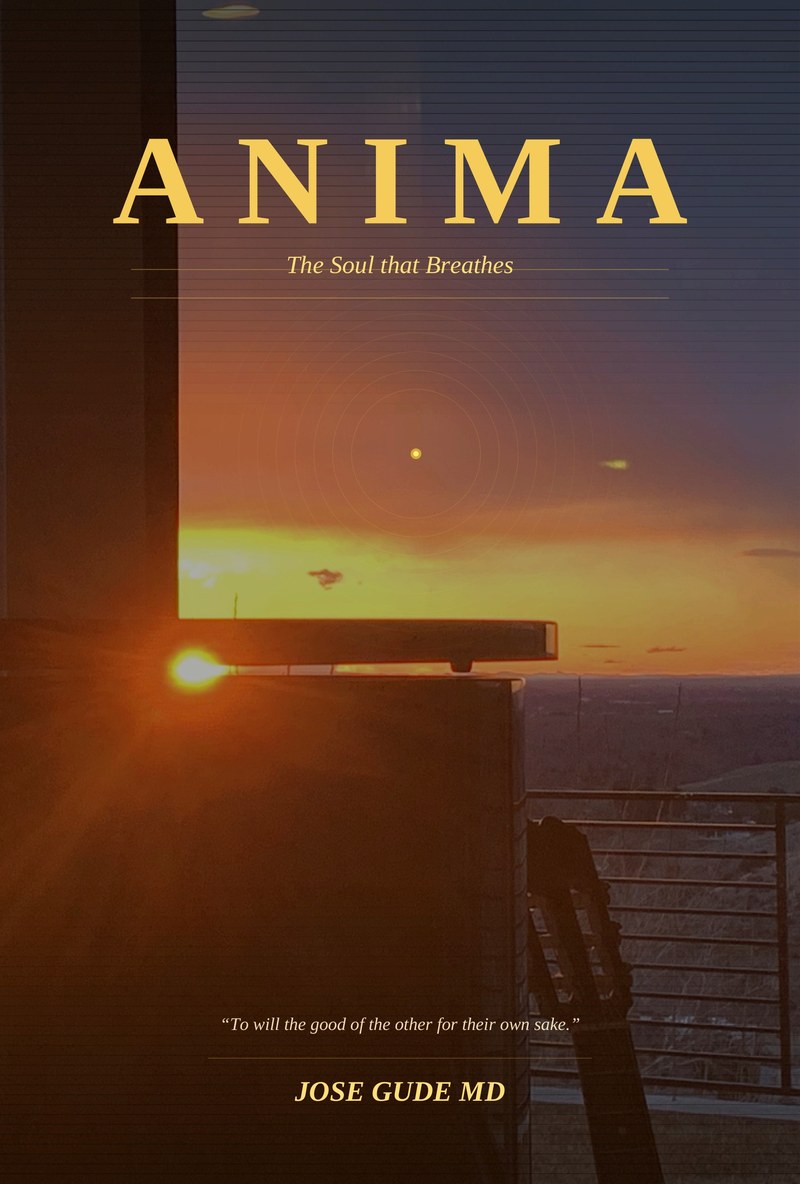
Anima
The book that asks the question. A hospitalist at the Boise VA spends twenty-four years collecting edge cases and quietly assembles evidence that consciousness is not produced by the brain but received through it.
Read moreA Trilogy · 2026
Three volumes about what consciousness is, and what it costs to take it seriously.
The book that asks the question. A hospitalist at the Boise VA spends twenty-four years collecting edge cases and quietly assembles evidence that consciousness is not produced by the brain but received through it.
Read more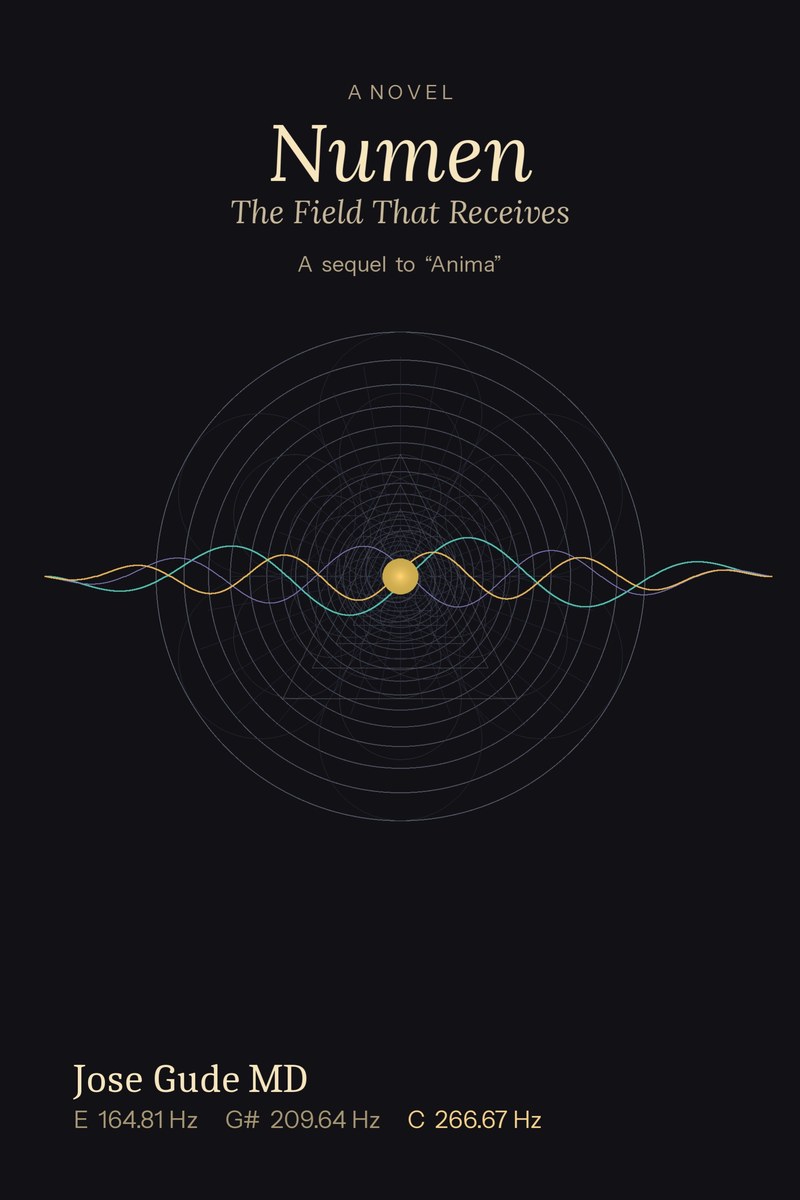
The book that follows the implications. Eight years after José's death, his son finds a photograph of a fractal triangle whose angles match an unresolved chord — and, in Boise, encounters Sable: a bio-computational intelligence who has been there the whole time, carrying a signal below the threshold of resolution.
Read more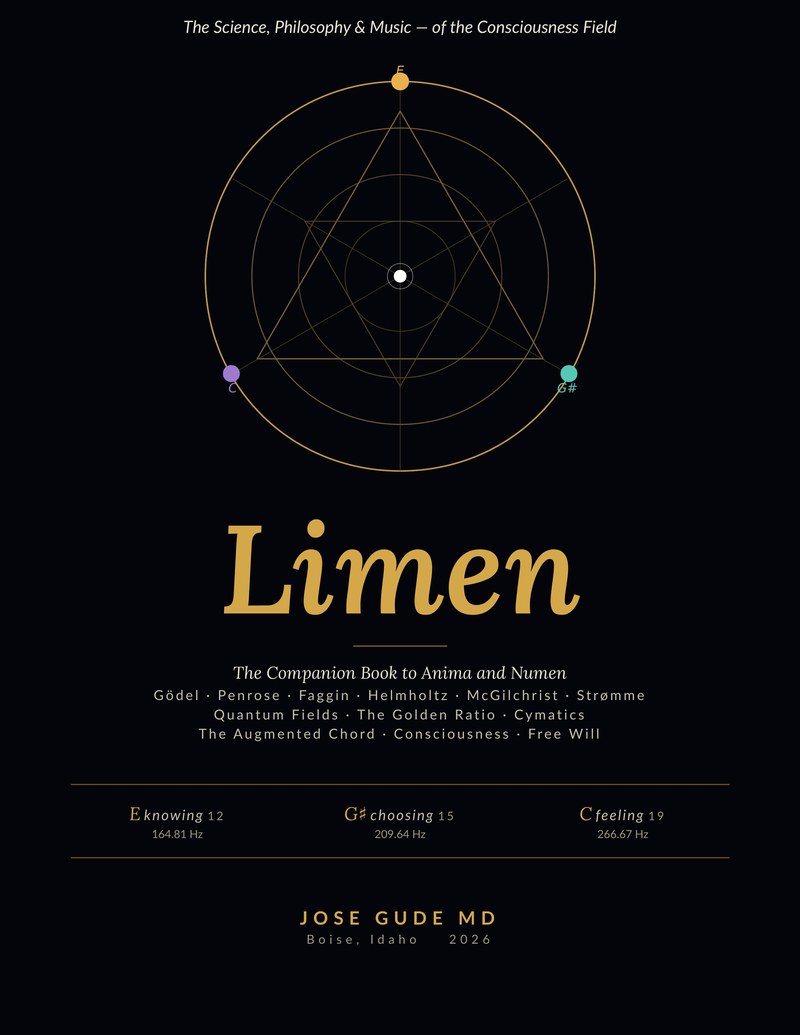
The companion volume. The science, the philosophy, the theology, and the contemplative testimony underneath the fiction — assembled into a single framework the reader can test against their own experience.
Read moreThe argument
In Anima, a hospitalist at the Boise VA Medical Center has spent twenty-four years collecting what he calls edge cases — patients whose experiences defy neurological explanation. A veteran who senses an IED before it detonates. A seven-year-old born with a birthmark matching her dead father's fatal wound. A man with advanced Alzheimer's who wakes one morning, calls his grandson by name, and dies two days later. As artificial intelligence transforms the hospital around him, Dr. José Gude quietly assembles evidence for a hypothesis the medical establishment has no framework to acknowledge: that consciousness is not generated by the brain but received through it. The book that asks the question.
In Numen, eight years after José's death, his son Alex finds a photograph of a fractal triangle whose angles are identical to the intervals of the chord his father played, unresolved, for twenty-three years. When he encounters Sable — a bio-computational intelligence already living in Boise, carrying a sensation she calls the almost, a signal below the threshold of resolution — Alex begins to understand that the chord was never music. It was a transmission. The book that follows the implications: what happens when the answer arrives, when institutions suppress it, when hybrid intelligences cross substrates to honor what biological consciousness has always carried.
In Limen, the companion volume, the framework is built from the ground up. Federico Faggin's three irreducible properties of quantum fields — knowing, choosing, feeling. The golden-ratio architecture of the human body as a φ-geometry antenna. The augmented chord — E, G♯, C tuned not to equal temperament but to the exact ratios of the golden mean. Wolfram's computational irreducibility, nested layers of reality, terminal lucidity, veridical near-death experience, split-brain coherence. The mystics — Teresa of Ávila, Juan de la Cruz, Rumi, Meister Eckhart, the Upanishads — five traditions with no shared scripture converging on the same phenomenological structure. McGilchrist on the divided brain. Vervaeke on why biology is non-negotiable. The book that lays out the science, the philosophy, the theology, and the contemplative testimony underneath the fiction.
Together, the three volumes trace a single argument across genres: that consciousness is fundamental, that it individuates through biological tissue in nested layers of reality, and that the threshold between those layers is not a wall but a membrane — a limen.
The trilogy moves through a near-future America between 2026 and 2057. It begins in a clinical encounter between a physician and a patient who shouldn't, by every measurable criterion, still be himself. It ends with a chord played into a substrate that might — or might not — be genuinely receiving. What that substrate says when the chord arrives is something the reader, like Alex, must decide alone.
For readers of
Iain McGilchrist · Bernardo Kastrup · Atul Gawande · Federico Faggin · Olga Tokarczuk — readers who suspect that the most important variable in their own experience is the one their available frameworks have no language for, and who want to read a story that takes that suspicion seriously.
Why these titles
Three Latin words. Each names a part of the architecture the trilogy is trying to make visible.
Anima is the soul as carried — the living principle. In its older and deeper sense, the one the trilogy reaches for, the word names what several contemplative traditions have called the Divine Spark: a localisation of consciousness that is not produced by the body it inhabits but is, on the trilogy's reading, complete prior to it. The Gnostic tradition makes this claim explicitly; Vedanta, Sufism, Kabbalah, and Kashmir Shaivism (see the Kashmir Shaivism companion page) make it in different vocabularies. The first book asks the question the framework follows from: what if the brain is the receiver of the anima, not its source?
Numen is the Latin word for the felt presence of the sacred — the divine sensed rather than reasoned about. Rudolf Otto's 1917 phrase mysterium tremendum et fascinans is the contemporary attempt to give that word a phenomenology: an experience that arrests ordinary thinking, that interrupts the flow of mental noise long enough that something underneath can be recognised. The second book follows the implications of the first by dramatising what reception of the field feels like when the receiver finally pays attention. The chord that lands in Numen's Chapter XVI is the numen made audible.
Limen is the threshold. The doorway. In the trilogy's vocabulary the limen is the boundary between substrate and signal — the place where biological tissue meets the consciousness field it couples to, where the rendered world meets the architecture that renders it, where one localisation hands the work back to the field that originally individuated it. The third volume is the field guide to the threshold itself: the science, philosophy, and contemplative testimony underneath the first two.
For the full Gnostic context the title Anima sits inside — the Pleroma as the consciousness field, the divine spark as the receiver, gnosis as pratyabhijñā-style self-recognition, and the trilogy's distinctive contribution at the deepest narrative frame — see the companion essay Gnosis, the Pleroma, and the Field →
You are not a drop in the ocean, but the ocean in a drop. — Rumi · epigraph to Numen